Laser Diffraction Particle Size Analyser
Measures the particle size distribution of powders, suspensions and emulsions from the pattern of laser light scattered by the particles. Reports D10, D50 and D90 within a minute or two.
- Pharmaceutical
- Biotech
- Chemicals
- Cosmetics
- Food & beverage
- Mining and cement
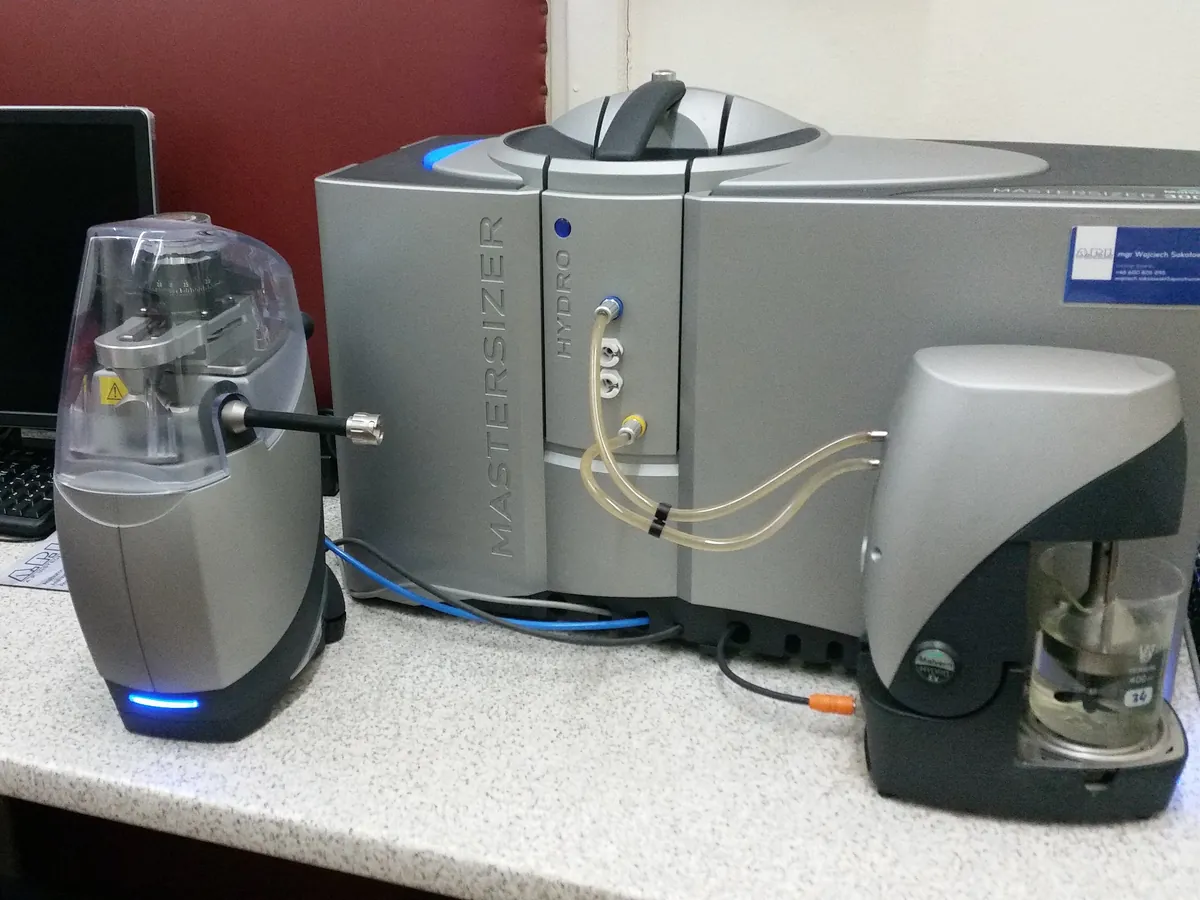
What is Laser diffraction PSA?
A laser diffraction analyser shines a laser beam through a cloud of dispersed particles. Large particles scatter light at small angles with high intensity; small particles scatter light at wider angles with lower intensity. A ring of detectors records how much light falls at each angle.
Software then uses an optical model (Mie theory or the Fraunhofer approximation) to work out which mix of particle sizes would produce that scattering pattern. The result is a volume-weighted size distribution, usually summarised as D10, D50 and D90 and the span.
In pharmaceutical QC it is the standard technique for API and excipient particle size. Particle size affects dissolution, content uniformity, flow, compression and, for inhaled products, where the drug lands in the lung. Samples can be measured dry (dispersed by compressed air) or wet (dispersed in a liquid in which they do not dissolve).
Used for
- Particle size distribution of APIs (often a critical material attribute)
- Excipient particle size on receipt (e.g. lactose, microcrystalline cellulose)
- Milling and micronisation control
- Suspension and emulsion droplet size
- Granule size in process development
- Comparing suppliers and batches during change control
How it works
- 01
Disperse
The sample is dispersed in air (dry unit) or a liquid (wet unit) so particles pass the beam one cloud at a time, not as clumps.
- 02
Illuminate
A collimated laser beam (often red, with a blue source for fine particles) passes through the measurement cell.
- 03
Scatter
Each particle scatters light; large particles at low angles, small particles at wide angles.
- 04
Detect
An array of detectors at forward, side and back angles records the scattered intensity at each angle.
- 05
Invert
Software applies Mie or Fraunhofer theory to calculate the size distribution that best fits the measured pattern.
- 06
Report
Results are given as a volume-weighted distribution with D10, D50, D90, span and a fit residual.
Advantages
- Fast: a measurement takes seconds to a few minutes
- Wide dynamic range, typically from below 1 µm to a few millimetres
- Highly repeatable when the method is properly developed
- Measures many thousands of particles, so results are statistically robust
- Both dry and wet dispersion are possible
Limitations
- Assumes particles are spheres; needles and plates give an 'equivalent spherical' size
- Mie theory needs the refractive index of the material and the dispersant
- Results depend strongly on dispersion conditions (air pressure, sonication, surfactant)
- Does not show particle shape; microscopy is needed to confirm agglomerates or shape
- Results from different instruments or models are not always directly comparable
1 calibration procedure
Methods that use Laser diffraction PSA
Keep every Laser diffraction PSA in control: usage logs, calibration and maintenance schedules, and automatic blocking of overdue instruments.