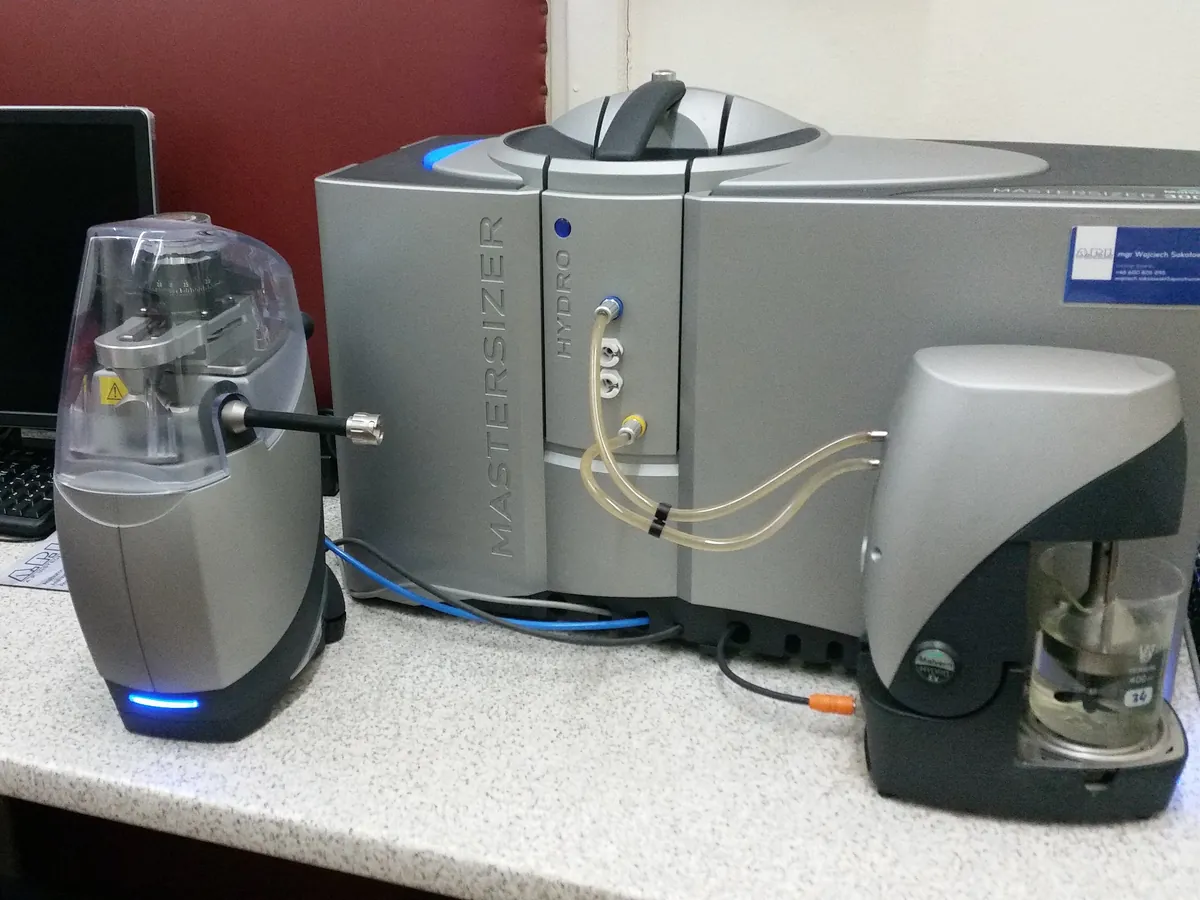
Laser Diffraction Particle Size Analyser
Measures the particle size distribution of powders, suspensions and emulsions from the pattern of laser light scattered by the particles. Reports D10, D50 and D90 within a minute or two.
- Pharmaceutical
- Biotech
- Chemicals
- Cosmetics
- Food & beverage
- Mining and cement
How Laser diffraction PSA works
Particles scatter light at an angle that is inversely related to their size. The instrument measures scattered intensity against angle and inverts this pattern, using an optical model, into the volume distribution of equivalent spheres that best fits it.
The path of a sample
- 01
Disperse
The sample is dispersed in air (dry unit) or a liquid (wet unit) so particles pass the beam one cloud at a time, not as clumps.
- 02
Illuminate
A collimated laser beam (often red, with a blue source for fine particles) passes through the measurement cell.
- 03
Scatter
Each particle scatters light; large particles at low angles, small particles at wide angles.
- 04
Detect
An array of detectors at forward, side and back angles records the scattered intensity at each angle.
- 05
Invert
Software applies Mie or Fraunhofer theory to calculate the size distribution that best fits the measured pattern.
- 06
Report
Results are given as a volume-weighted distribution with D10, D50, D90, span and a fit residual.
Main parts and what they do
Laser light source(s)
Produce a stable, collimated beam; a second shorter-wavelength source improves resolution of sub-micron particles.
Measurement cell
Optical cell with clean windows through which the dispersed sample passes.
Detector array
Forward, side and back-scatter detectors that record intensity at many angles.
Dry dispersion unit
Feeds powder from a vibrating tray into a venturi where compressed air breaks up agglomerates.
Wet dispersion unit
Stirred tank with pump and built-in sonication that circulates the suspension through the cell.
Software
Controls the measurement, applies the optical model, stores SOPs and results with an audit trail.
Terms every analyst should know
D10, D50, D90
The sizes below which 10%, 50% and 90% of the sample volume lies. D50 is the volume median diameter.
Span
Width of the distribution: (D90 − D10) ÷ D50. A smaller span means a narrower distribution.
Obscuration
The fraction of laser light blocked by the sample. It must sit in the method's range: too low gives noise, too high gives multiple scattering.
Mie vs Fraunhofer
Mie theory uses refractive indices and is accurate for fine particles; Fraunhofer needs no optical data but is only reliable for larger, opaque particles.
Equivalent spherical diameter
The diameter of a sphere that would scatter light in the same way as the real particle.
Residual
How well the calculated pattern fits the measured one. A high residual suggests a wrong optical model or poor dispersion.
Keep every Laser diffraction PSA in control: usage logs, calibration and maintenance schedules, and automatic blocking of overdue instruments.