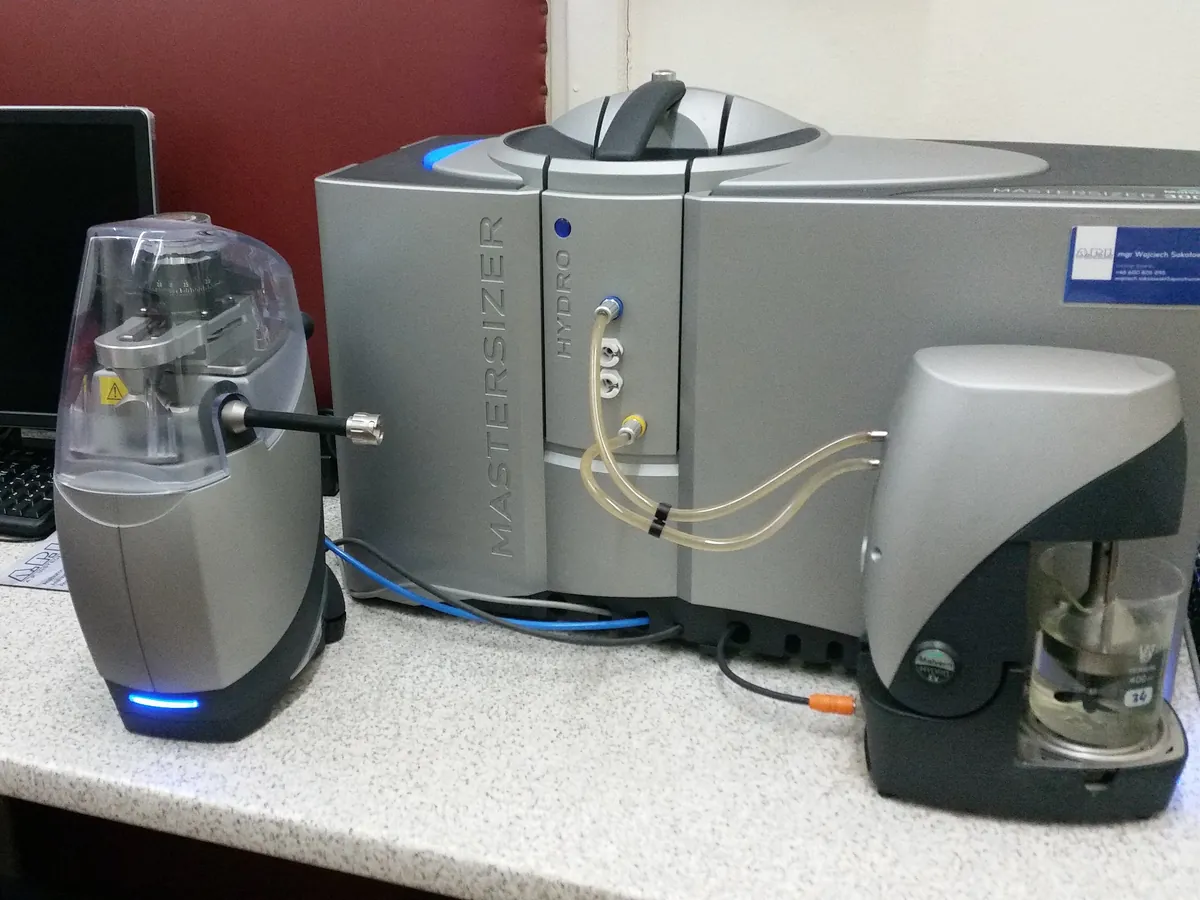
Laser Diffraction Particle Size Analyser
Measures the particle size distribution of powders, suspensions and emulsions from the pattern of laser light scattered by the particles. Reports D10, D50 and D90 within a minute or two.
- Pharmaceutical
- Biotech
- Chemicals
- Cosmetics
- Food & beverage
- Mining and cement
Test your Laser diffraction PSA knowledge
Multiple-choice questions
Pick an answer to see whether you are right and why.
Q1. In laser diffraction, large particles scatter light:
basicQ2. D50 in a laser diffraction report is:
basicQ3. A sample has D10 = 10 µm, D50 = 40 µm and D90 = 90 µm. What is the span?
intermediateQ4. Which information does Mie theory need that the Fraunhofer approximation does not?
intermediateQ5. Replicate wet measurements of the same aliquot get steadily smaller. The most likely cause is:
intermediateQ6. For a certified reference material check, typical acceptance for D50 is within:
advancedQ7. Why should needle-shaped crystals be checked by microscopy as well as laser diffraction?
advanced
Viva questions
Think of your answer first, then open it to compare.
1. What is obscuration and why must it be in a set range?
Obscuration is the fraction of laser light blocked by the sample. Too little sample gives a weak, noisy signal; too much causes multiple scattering, where light is scattered by more than one particle, making results look finer. The validated method sets a range, e.g. 10–20% for a wet method.
2. How do you choose between wet and dry dispersion?
Dry dispersion suits free-flowing powders that are not damaged by air pressure and is fast with no solvent. Wet dispersion suits cohesive or fragile powders but needs a dispersant in which the sample does not dissolve, often with surfactant. The choice is justified in method development, for example with a pressure or sonication titration.
3. Why is API particle size often a critical material attribute?
Smaller particles have more surface area, so poorly soluble drugs dissolve faster. Particle size also affects blend and content uniformity (especially at low dose), flow and compression. For inhaled products it decides where the drug is deposited in the lung.
Keep every Laser diffraction PSA in control: usage logs, calibration and maintenance schedules, and automatic blocking of overdue instruments.