High Performance Liquid Chromatography (HPLC)
Separates the components of a liquid sample on a packed column and measures each one as it leaves. The workhorse of pharmaceutical QC for assay, impurities and dissolution.
- Pharmaceutical
- Biotech
- Food & beverage
- Environmental
- Cosmetics
- Chemicals
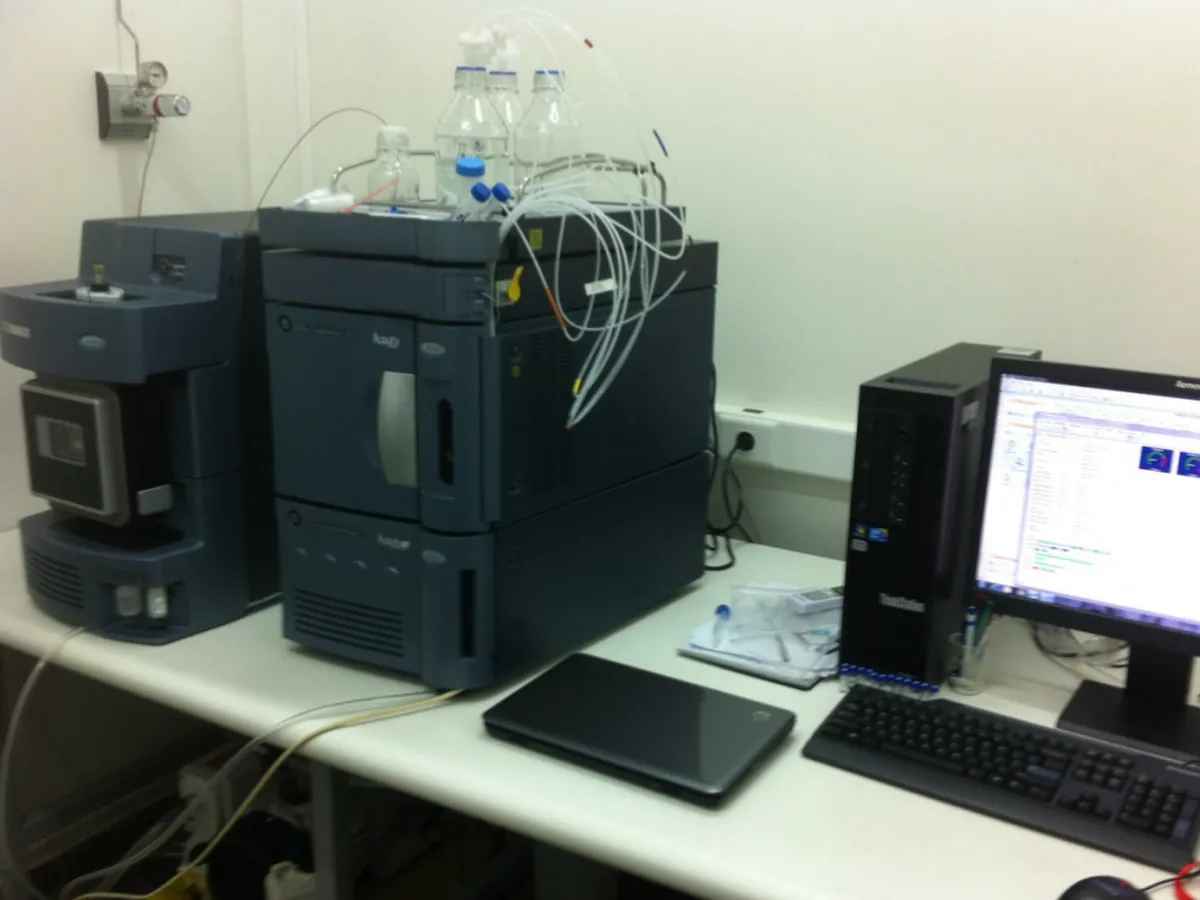
How HPLC works
Separation is based on how strongly each component is held by the stationary phase compared with the mobile phase. In reversed-phase HPLC, the most common mode in pharma, the column is non-polar (C18) and the mobile phase is polar (water or buffer with methanol or acetonitrile), so polar compounds elute first and non-polar compounds are retained longer.
The path of a sample
- 01
Mobile phase
Filtered, degassed solvent or buffer is drawn from the reservoirs.
- 02
Pump
Delivers a constant, pulse-free flow at high pressure (typically up to 400 bar for HPLC).
- 03
Injector
The autosampler injects a precise sample volume into the flowing stream.
- 04
Column
Components separate as they partition between the stationary and mobile phases.
- 05
Detector
Measures each component as it elutes (UV absorbance in most QC methods).
- 06
Data system
Records the chromatogram, integrates peaks and calculates results.
Main parts and what they do
Solvent reservoirs
Hold the mobile-phase solvents and buffers, usually with an inlet filter on each line.
Degasser
Removes dissolved air so bubbles do not disturb the pump or detector.
Pump (binary or quaternary)
Delivers the mobile phase at a precise flow rate and, for gradients, mixes solvents in set proportions.
Autosampler / injector
Draws the sample from a vial and injects a fixed volume through a sample loop.
Column
Stainless-steel tube packed with stationary phase (e.g. C18 silica, 250 × 4.6 mm, 5 µm) where separation happens.
Column oven
Keeps the column at a constant temperature so retention times are reproducible.
Detector
UV-Vis or photodiode-array (PDA) in most QC methods; refractive index, fluorescence or mass spectrometry for special cases.
Chromatography data system (CDS)
Controls the instrument, acquires and integrates data, and keeps the audit trail.
Terms every analyst should know
Retention time (tR)
Time from injection to the top of a peak. Used to identify a component under fixed conditions.
Resolution (Rs)
How well two neighbouring peaks are separated. Rs ≥ 1.5 means baseline separation.
Theoretical plates (N)
A measure of column efficiency. Higher N gives sharper, narrower peaks.
Tailing factor (T)
Peak symmetry. 1.0 is perfectly symmetrical; most methods require T ≤ 2.0.
Isocratic vs gradient
Isocratic keeps mobile-phase composition constant; gradient changes it during the run to elute strongly retained compounds.
Normal vs reversed phase
Normal phase uses a polar column and non-polar solvent; reversed phase is the opposite and is far more common.
Keep every HPLC in control: usage logs, calibration and maintenance schedules, and automatic blocking of overdue instruments.