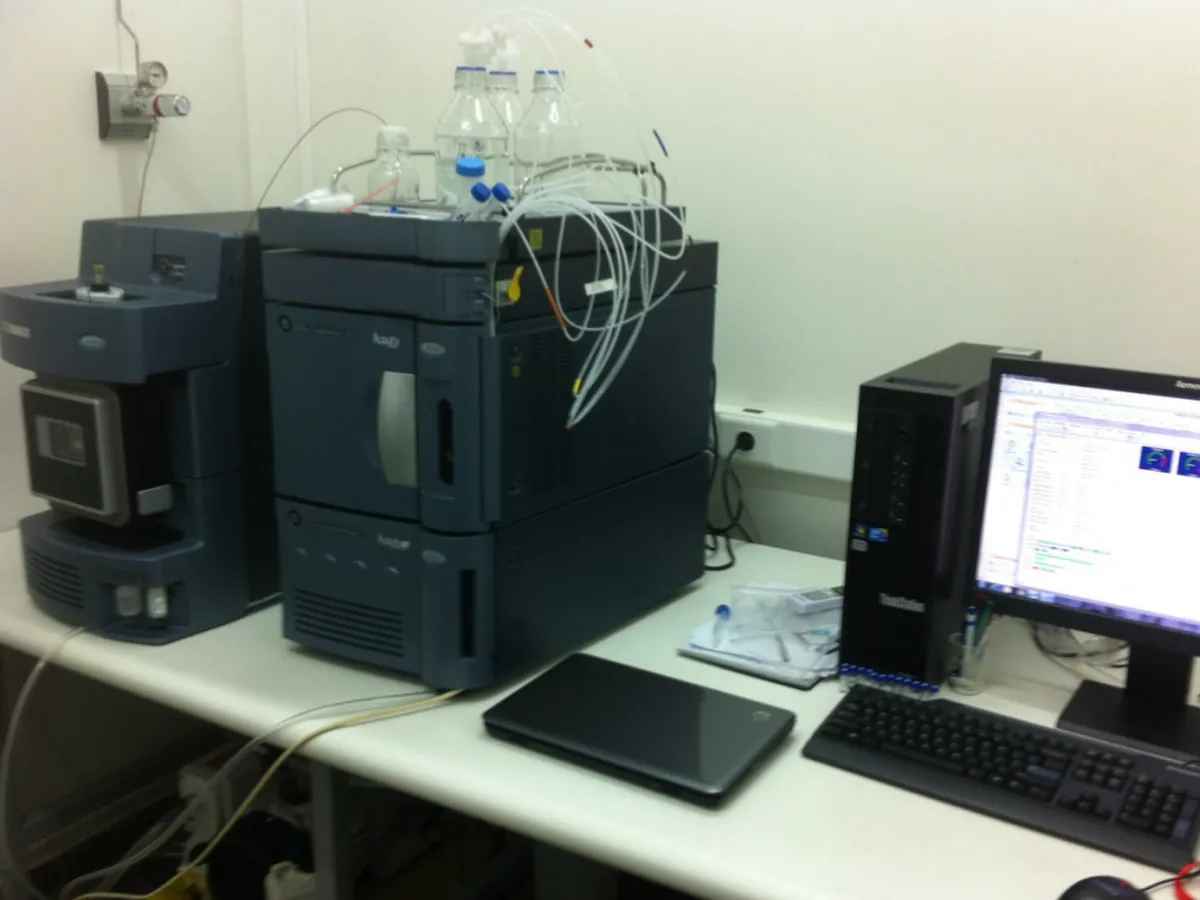
High Performance Liquid Chromatography (HPLC)
Separates the components of a liquid sample on a packed column and measures each one as it leaves. The workhorse of pharmaceutical QC for assay, impurities and dissolution.
- Pharmaceutical
- Biotech
- Food & beverage
- Environmental
- Cosmetics
- Chemicals
Test your HPLC knowledge
Multiple-choice questions
Pick an answer to see whether you are right and why.
Q1. Which HPLC component delivers the mobile phase at high pressure?
basicQ2. In reversed-phase HPLC, which statement is correct?
basicQ3. What does retention time tell you?
basicQ4. Two peaks are considered baseline-separated when resolution (Rs) is at least:
intermediateQ5. A tailing factor of 1.0 means the peak is:
intermediateQ6. Why is the mobile phase degassed before use?
intermediateQ7. Retention times are drifting steadily later through a sequence. The most likely cause is:
intermediateQ8. Which test is part of HPLC operational qualification (OQ)?
advancedQ9. System suitability fails because the %RSD of replicate standard injections is 3.5%. What should you do?
advancedQ10. Before shutting down after a buffer method, you should first:
advanced
Viva questions
Think of your answer first, then open it to compare.
1. What is the difference between isocratic and gradient elution?
Isocratic elution keeps the mobile-phase composition constant for the whole run. Gradient elution changes the composition (usually increasing the organic proportion) during the run, which helps elute strongly retained components and sharpen late peaks.
2. What is system suitability and why is it done before every run?
System suitability is a set of checks (for example %RSD of replicate injections, tailing factor, theoretical plates and resolution) that confirm the complete system — instrument, column, reagents and analyst — is working properly on the day. It is done before sample analysis because results are only valid if the system was suitable at that time.
3. Why do we use a guard column?
A guard column is a short cartridge with the same packing placed before the analytical column. It traps particles and strongly retained matrix components, protecting the expensive analytical column and extending its life.
4. How do you choose the detection wavelength for an HPLC method?
Scan the analyte's UV spectrum and choose a wavelength near its absorbance maximum for sensitivity, where the mobile phase does not absorb strongly and interfering compounds absorb little. For impurity methods a wavelength that suits all relevant impurities may be chosen.
5. What are DQ, IQ, OQ and PQ for an HPLC?
Design qualification confirms the chosen model meets the user requirements; installation qualification confirms correct delivery and installation; operational qualification tests each module against its specifications; performance qualification shows the system performs consistently for its intended use, for example through regular system suitability.
Keep every HPLC in control: usage logs, calibration and maintenance schedules, and automatic blocking of overdue instruments.