Gloss meter
Shines a beam of light onto a surface at a fixed angle and measures how much is reflected in the mirror direction. The result is given in gloss units (GU), relative to a polished black glass standard.
- Paints & coatings
- Polymers & plastics
- Printing & packaging
- Automotive
- Furniture
- Cosmetics
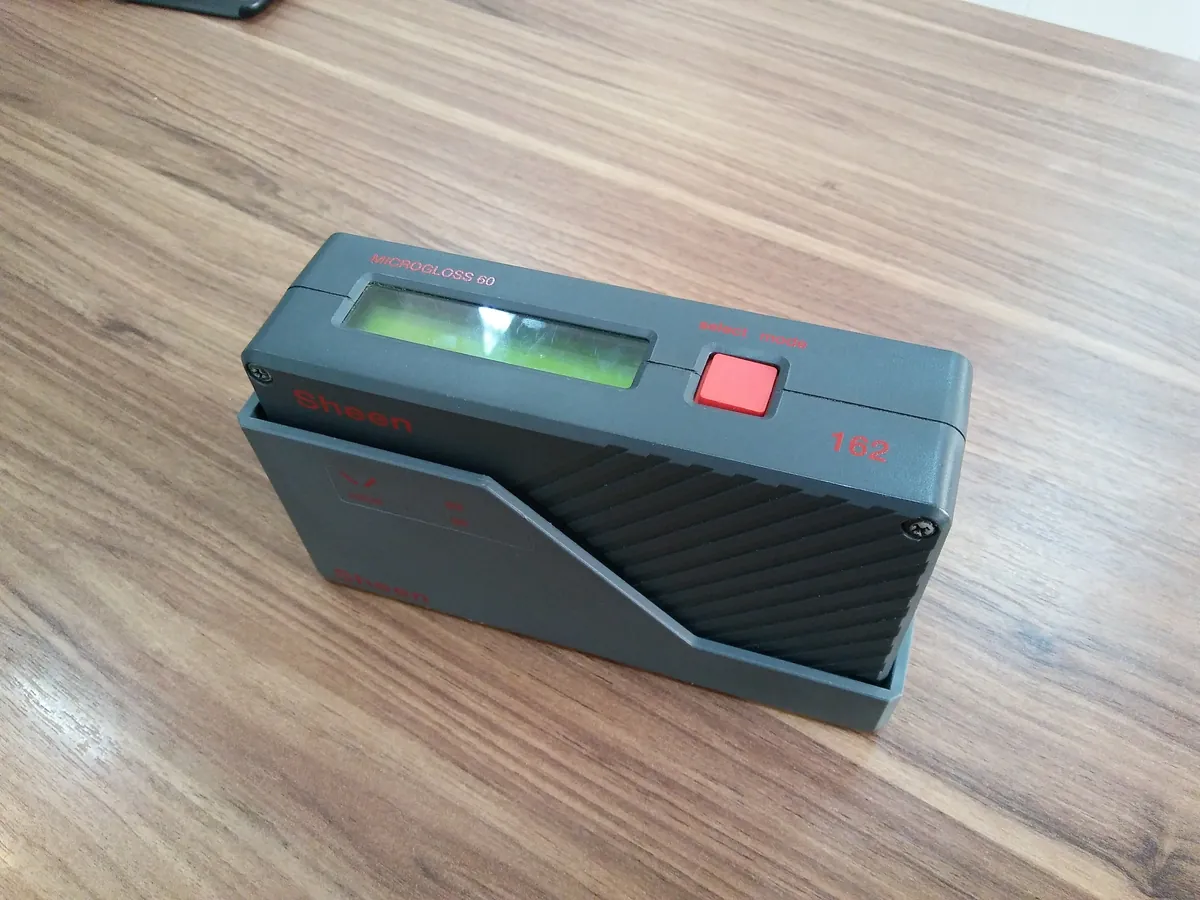
What is Gloss meter?
Gloss is how shiny a surface looks. It matters for paints, coatings, printed packaging, plastics and cosmetics, where the customer expects a matt, satin or high-gloss finish and the batch must match the standard. A gloss meter measures specular reflectance, the light reflected at the same angle as it arrives, which is what the eye sees as shine.
Gloss meters follow ISO 2813 and ASTM D523. They use three standard angles of incidence: 20°, 60° and 85°. The 60° geometry suits most surfaces. 20° gives better separation between high-gloss samples, and 85° gives better separation between matt samples.
The scale is defined by a highly polished black glass with a refractive index of 1.567, which is given a value of 100 GU at each geometry. A perfect mirror would read about 1000 GU at 60°, so metallic and mirror-like surfaces can exceed 100. Matt surfaces read close to 0.
Used for
- Batch release of paints, varnishes and powder coatings against a gloss specification
- Checking finish uniformity on coated panels, furniture and automotive parts
- Gloss retention after weathering or UV exposure tests
- Gloss of plastic mouldings, films and printed packaging
- Polishing and cleaning studies on floors, stone and metal
How it works
- 01
Calibrate
The instrument is set using its calibration tile, whose value is traceable to the primary black glass standard.
- 02
Choose geometry
Measure at 60°. If the reading is above about 70 GU, use 20°; if below about 10 GU, use 85°.
- 03
Place
The meter sits flat on a clean, flat area of the test panel.
- 04
Measure
Light reflected at the mirror angle reaches the detector and is converted to gloss units.
- 05
Average
Several readings across the panel are averaged and the range is reported.
Advantages
- Objective and quick, replacing visual judgement
- Portable, battery-powered and non-destructive
- Standard geometries make results comparable across labs
- Tri-angle instruments measure 20°, 60° and 85° at once
Limitations
- Measures only specular gloss; it does not describe haze, orange peel or distinctness of image
- Curved, small or textured surfaces give unreliable readings
- Results on metallic or mirror-like surfaces can exceed 100 GU and are less comparable
- Readings depend on colour slightly and on the cleanliness of both sample and standard
1 calibration procedure
Methods that use Gloss meter
Keep every Gloss meter in control: usage logs, calibration and maintenance schedules, and automatic blocking of overdue instruments.