Gloss meter
Shines a beam of light onto a surface at a fixed angle and measures how much is reflected in the mirror direction. The result is given in gloss units (GU), relative to a polished black glass standard.
- Paints & coatings
- Polymers & plastics
- Printing & packaging
- Automotive
- Furniture
- Cosmetics
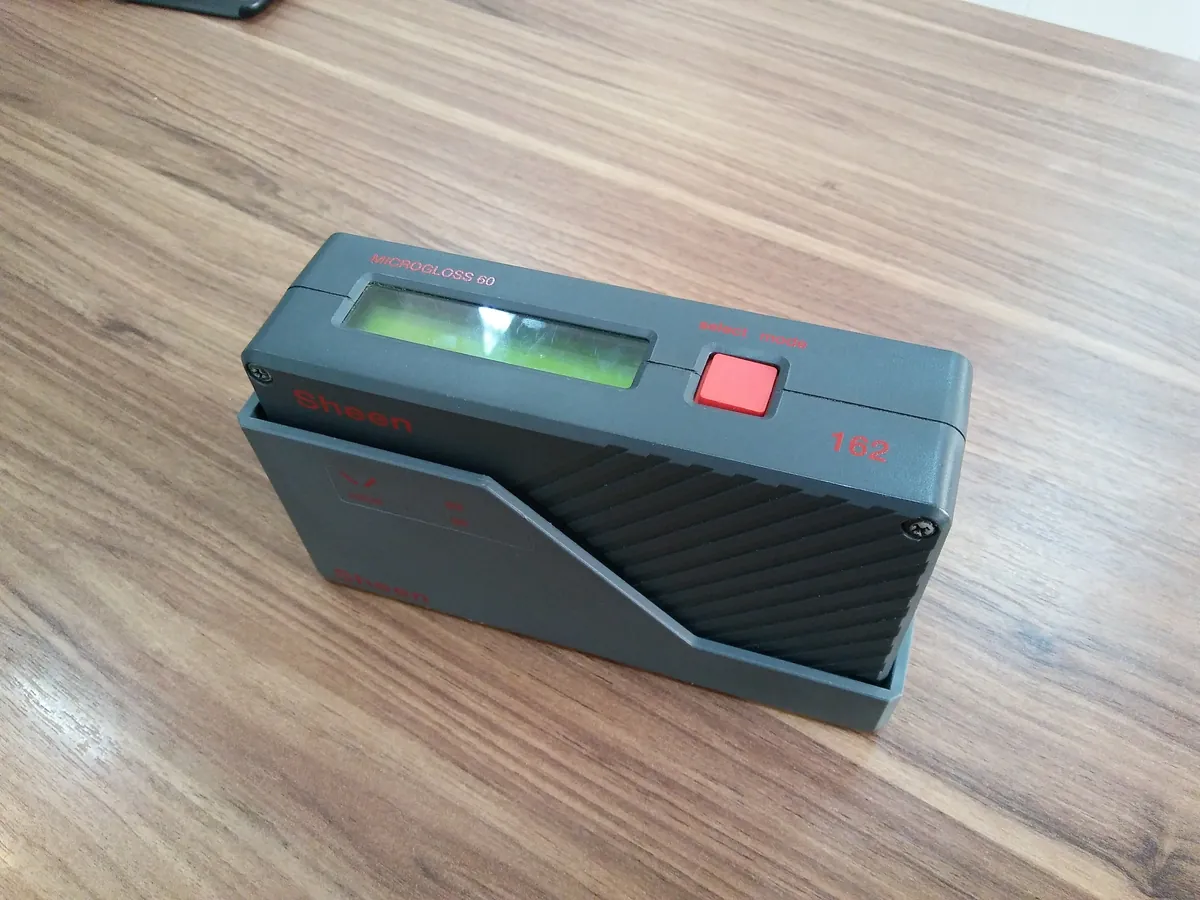
How Gloss meter works
A light source and lens send a parallel beam onto the surface at the chosen angle. A detector at the mirror angle collects the specularly reflected light through an aperture of defined size. The signal is compared with that from the black glass reference, which is assigned 100 GU, so gloss (GU) = (sample signal ÷ standard signal) × standard value.
The path of a sample
- 01
Calibrate
The instrument is set using its calibration tile, whose value is traceable to the primary black glass standard.
- 02
Choose geometry
Measure at 60°. If the reading is above about 70 GU, use 20°; if below about 10 GU, use 85°.
- 03
Place
The meter sits flat on a clean, flat area of the test panel.
- 04
Measure
Light reflected at the mirror angle reaches the detector and is converted to gloss units.
- 05
Average
Several readings across the panel are averaged and the range is reported.
Main parts and what they do
Light source
Lamp or LED with a filter that matches the CIE illuminant C or a similar response.
Collimating optics
Produce a parallel beam at the fixed angle of incidence.
Receptor optics and detector
Collect light reflected at the mirror angle through a standard aperture and convert it to a signal.
Calibration tile
High-gloss black glass or ceramic tile with assigned GU values, stored in the instrument holder.
Display and memory
Shows GU at each geometry and stores readings, statistics and batch data.
Terms every analyst should know
Gloss unit (GU)
A relative unit: polished black glass of refractive index 1.567 reads 100 GU at every geometry.
Geometry
The angle of incidence, 20°, 60° or 85°, measured from the perpendicular to the surface. Always report it with the result.
Specular reflection
Light reflected at an angle equal and opposite to the incident angle. Smooth surfaces reflect more light specularly.
Aperture
The detector opening defined in the standard. It sets how much scattered light near the mirror angle is accepted.
Haze
Light scattered just beside the specular angle, which makes high-gloss surfaces look milky. Measured by separate instruments.
Keep every Gloss meter in control: usage logs, calibration and maintenance schedules, and automatic blocking of overdue instruments.