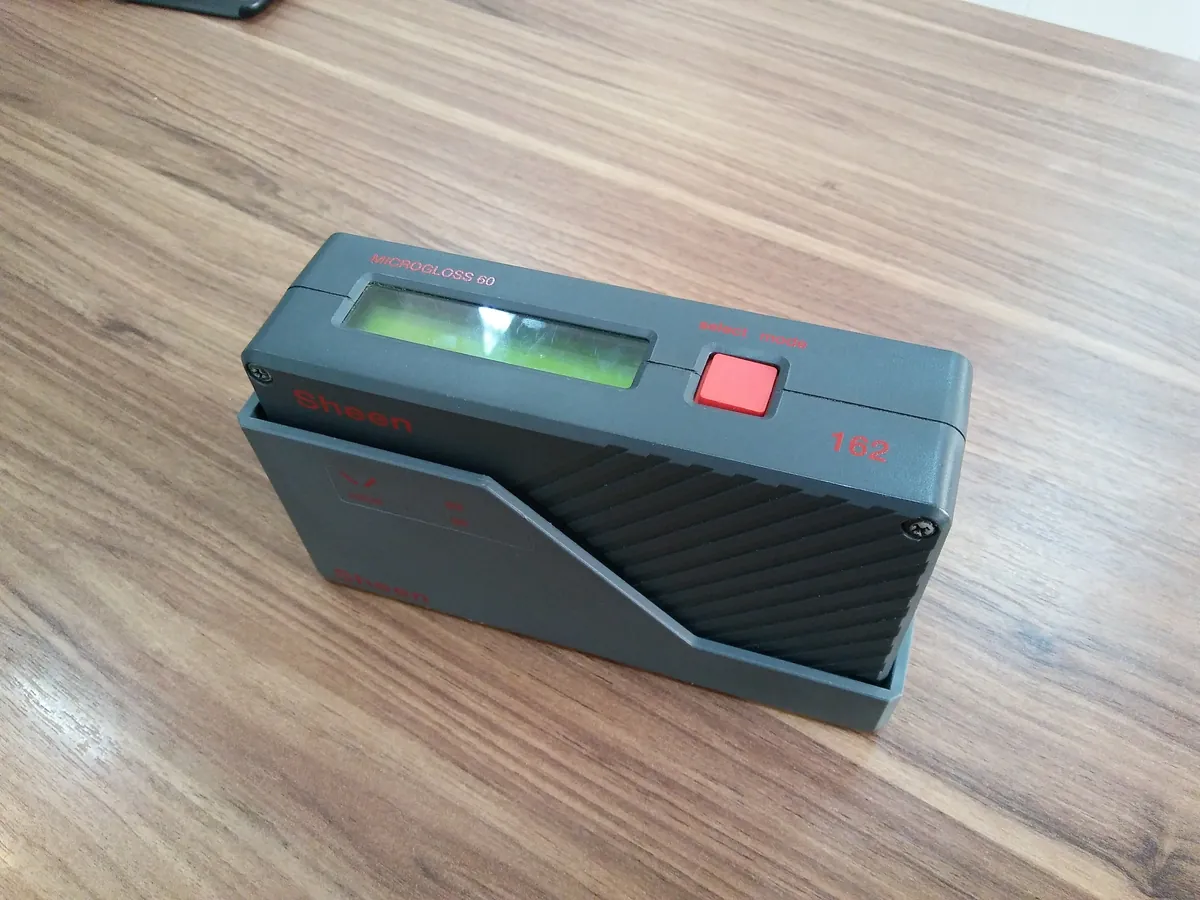
Gloss meter
Shines a beam of light onto a surface at a fixed angle and measures how much is reflected in the mirror direction. The result is given in gloss units (GU), relative to a polished black glass standard.
- Paints & coatings
- Polymers & plastics
- Printing & packaging
- Automotive
- Furniture
- Cosmetics
Test your Gloss meter knowledge
Multiple-choice questions
Pick an answer to see whether you are right and why.
Q1. Which geometry is used for most coatings as a first measurement?
basicQ2. What defines 100 gloss units?
basicQ3. A coating reads 85 GU at 60°. Which geometry should also be used?
intermediateQ4. A matt paint reads 4 GU at 60°. Which geometry is better?
intermediateQ5. A polished chrome surface reads 450 GU. What does this mean?
intermediateQ6. Which appearance property does a standard 20/60/85° gloss meter NOT measure?
advanced
Viva questions
Think of your answer first, then open it to compare.
1. How do you look after the gloss meter calibration tile?
Keep it in its holder, clean it only with lens tissue, never touch the glass surface, check for scratches, and have it recertified at the stated interval.
2. Why can two panels of the same paint batch give different gloss values?
Gloss depends on film thickness, substrate flatness, application method, drying or stoving conditions and surface contamination, so panels must be prepared the same way.
3. Why are there three geometries, and how do you choose between them?
One angle cannot separate all gloss levels well. Measure at 60° first; above about 70 GU use 20° to separate high-gloss samples, below about 10 GU use 85° to separate matt samples. Always report the geometry with the result.
Keep every Gloss meter in control: usage logs, calibration and maintenance schedules, and automatic blocking of overdue instruments.