Gas Chromatography–Mass Spectrometry (GC-MS)
Couples a gas chromatograph to a mass spectrometer so each volatile compound is separated and then identified from its fragmentation pattern. Used for unknown volatile impurities, nitrosamines, residual solvent confirmation and extractables.
- Pharmaceutical
- Environmental
- Forensic and toxicology
- Food & flavour
- Petrochemical
- Packaging
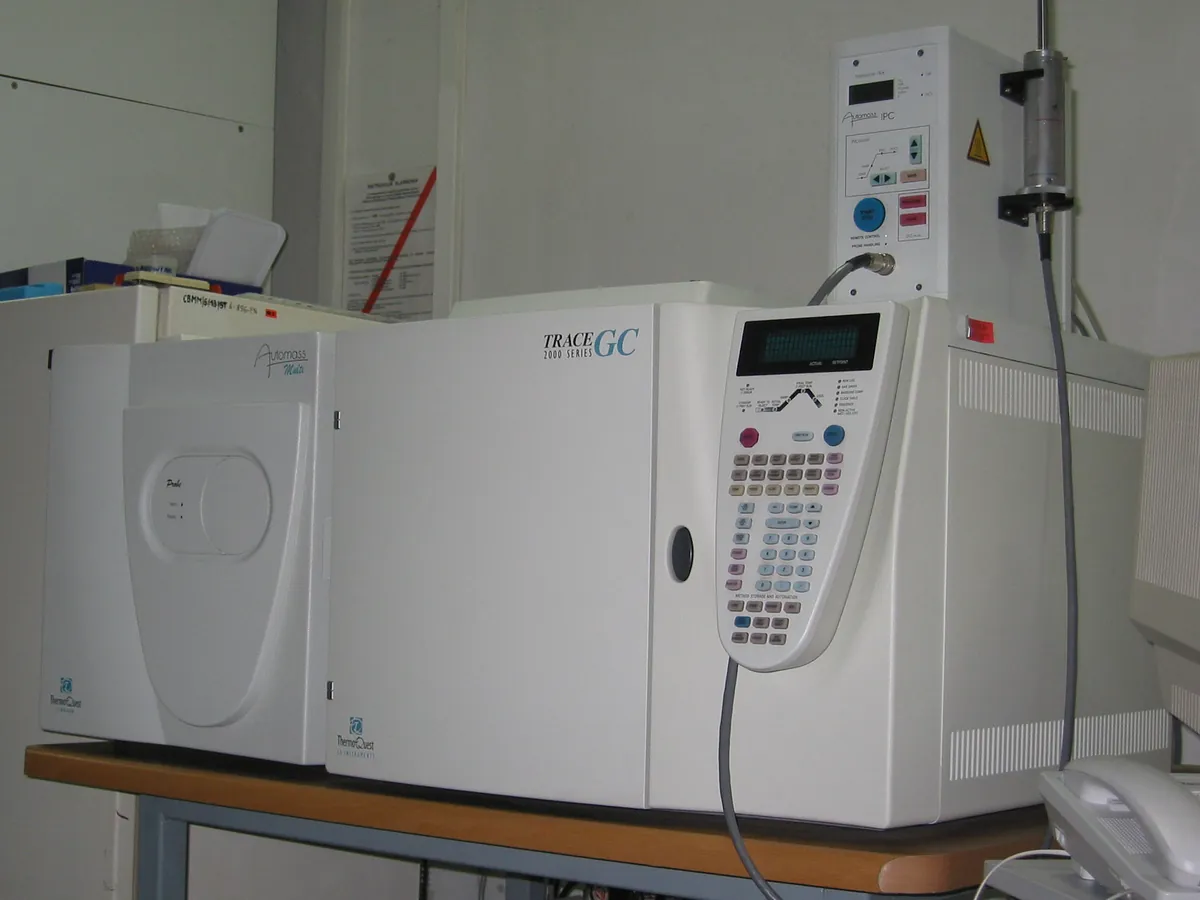
What is GC-MS?
A GC-MS uses a gas chromatograph to separate volatile and semi-volatile compounds, exactly as a GC-FID does. The column outlet passes through a heated transfer line straight into the vacuum of a mass spectrometer, because the GC carrier gas (usually helium) is easily pumped away.
Most GC-MS instruments use electron ionisation (EI). Molecules are hit by a beam of electrons at 70 eV, which knocks off an electron and breaks the molecule into characteristic fragments. Because 70 eV is a world-wide standard, the fragment pattern (the mass spectrum) is reproducible and can be searched against large reference libraries such as the NIST library.
In pharma QC, GC-MS is used to identify unknown volatile peaks, to confirm residual solvents, to measure trace mutagenic impurities such as nitrosamines, alkyl halides and alkyl sulfonates, and to study extractables and leachables from packaging. Single quadrupole instruments are most common; triple quadrupole GC-MS/MS adds selectivity for the lowest limits.
Used for
- Identification of unknown volatile peaks in residual solvent or impurity tests
- Nitrosamine impurities (e.g. NDMA, NDEA) by GC-MS or GC-MS/MS
- Mutagenic alkylating impurities (alkyl halides, alkyl mesylates and tosylates)
- Extractables and leachables from containers, closures and single-use systems
- Essential oils, flavours and natural product profiling
- Environmental and forensic analysis
How it works
- 01
Injection
The sample is vaporised in a heated split / splitless inlet, or introduced by headspace or thermal desorption.
- 02
GC separation
Compounds separate on a low-bleed capillary column (often 30 m × 0.25 mm) under a temperature programme.
- 03
Transfer line
A heated line carries the column outlet into the MS vacuum without condensation.
- 04
EI ion source
A filament emits electrons at 70 eV that ionise and fragment the molecules.
- 05
Quadrupole analyser
Filters ions by m/z, either scanning (e.g. m/z 35–500) or in SIM mode.
- 06
Detector and library search
An electron multiplier records ions; spectra are compared with a reference library to suggest an identity.
Advantages
- Library-searchable EI spectra for confident identification
- High separating power of capillary GC
- Very sensitive in selected ion monitoring (SIM) or MRM modes
- Robust, mature technique with well-understood performance checks
Limitations
- Only for compounds that are volatile and thermally stable (or can be derivatised)
- EI can fragment molecules so much that the molecular ion is weak or absent
- Requires high vacuum and clean helium (or careful use of hydrogen)
- Active sites in the inlet or column can degrade sensitive compounds
1 calibration procedure
Keep every GC-MS in control: usage logs, calibration and maintenance schedules, and automatic blocking of overdue instruments.