Spectroscopy
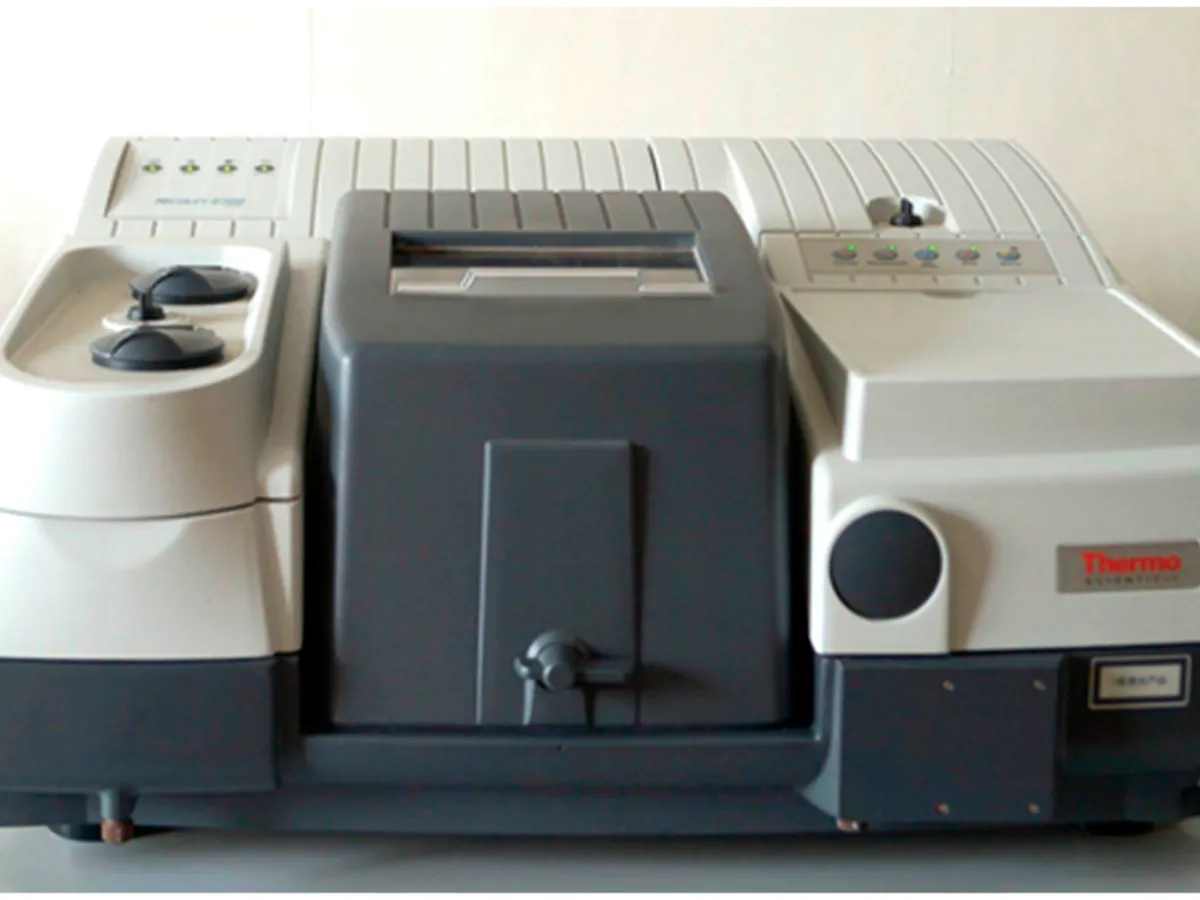
Fourier Transform Infrared (FTIR) Spectrometer
Records the infrared absorption spectrum of a sample, which acts as a molecular fingerprint. The standard technique for identification of APIs and excipients in pharma QC.
- Pharmaceutical
- Polymers & plastics
- Chemicals
- Forensics
- Food
- Academic research
TROUBLESHOOTING
Common problems, causes and fixes
Large water vapour or CO₂ bands
Likely causes
- • Old background spectrum
- • Exhausted desiccant or no purge
- • Sample compartment left open
What to do
- • Collect a new background just before the sample
- • Replace the desiccant or restore purge
- • Keep the compartment closed and allow it to settle
Weak spectrum, low band intensities (ATR)
Likely causes
- • Poor contact between sample and crystal
- • Too little sample
- • Hard crystalline sample
What to do
- • Increase clamp pressure to the set position
- • Cover the whole crystal area
- • Grind the sample finely before measuring
Cloudy KBr disc or sloping baseline
Likely causes
- • Wet KBr
- • Sample not ground finely enough (scattering)
- • Too much sample
What to do
- • Dry the KBr and work quickly in low humidity
- • Grind sample and KBr together thoroughly
- • Reduce the amount of sample
Broad band near 3400 cm⁻¹ and band near 1640 cm⁻¹ in a KBr spectrum
Likely causes
- • Moisture absorbed by KBr
What to do
- • Dry the KBr, store it in a desiccator and prepare discs quickly
- • Compare against a blank KBr disc
Flat-topped (saturated) bands
Likely causes
- • Disc too concentrated or too thick
What to do
- • Reduce the amount of sample in the disc or use ATR
Low energy or no interferogram
Likely causes
- • Source failure
- • Misalignment
- • Laser fault
- • Fogged KBr optics from humidity
What to do
- • Check the diagnostic page
- • Run the auto-alignment if available
- • Call service for source, laser or optics replacement
Sample and reference spectra differ but the material is expected to be correct
Likely causes
- • Different polymorph or hydrate
- • Different measurement technique (ATR vs KBr)
- • Contamination on the crystal
What to do
- • Follow the monograph's instructions to recrystallise or dissolve and evaporate both sample and reference, then repeat
- • Use the same technique for both
- • Clean the crystal and re-measure
In LimsPulse · Calibration Management
Keep every FTIR in control: usage logs, calibration and maintenance schedules, and automatic blocking of overdue instruments.