Spectroscopy
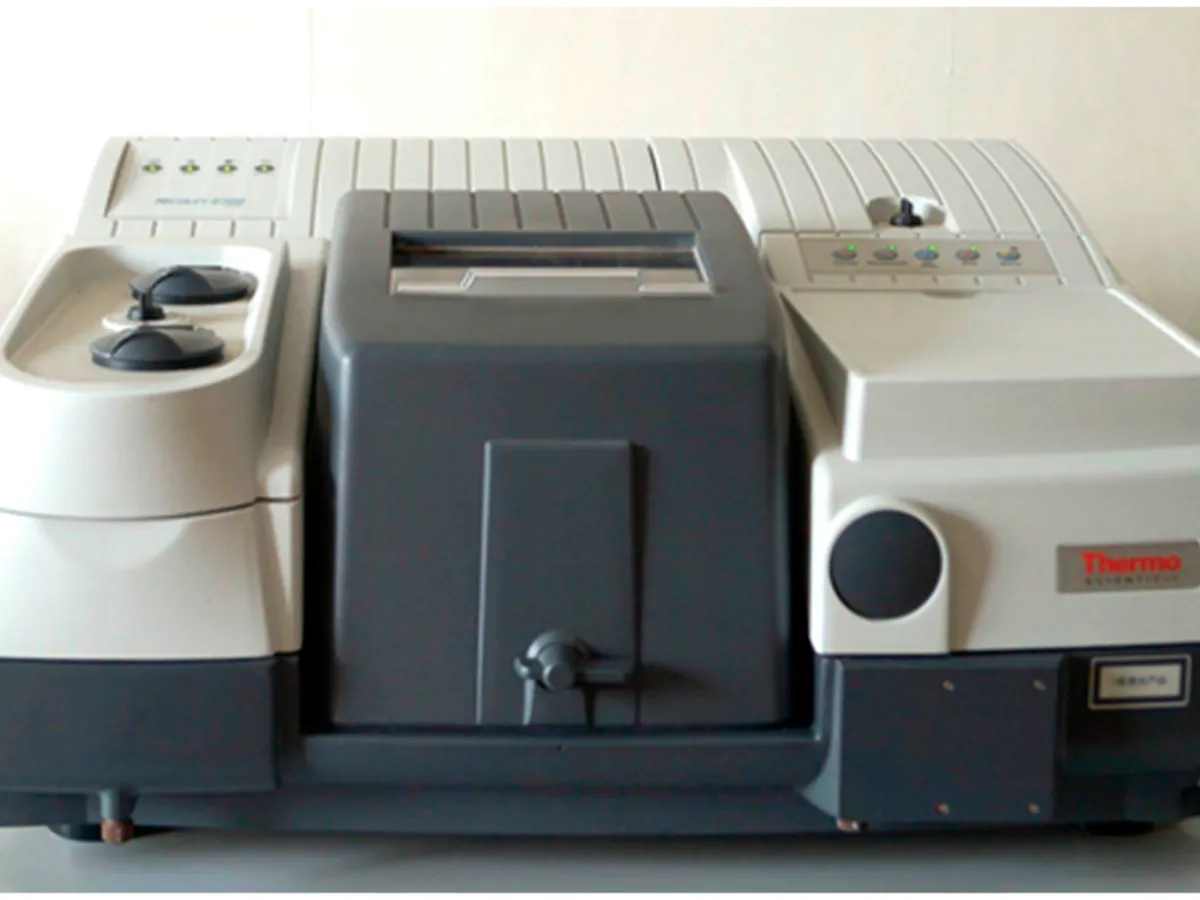
Fourier Transform Infrared (FTIR) Spectrometer
Records the infrared absorption spectrum of a sample, which acts as a molecular fingerprint. The standard technique for identification of APIs and excipients in pharma QC.
- Pharmaceutical
- Polymers & plastics
- Chemicals
- Forensics
- Food
- Academic research
Follow your site SOP
This is a typical operating sequence for learning. Your instrument model and approved SOP take precedence.
STAGE 1
Before you start
- 1Check the calibration status, the humidity indicator (desiccant colour) and the logbook.
- 2Choose the technique the specification requires (ATR, KBr disc, film, or liquid cell) and use the same technique for sample and reference.
- 3For KBr, dry the KBr powder as per the SOP and keep it in a desiccator.
- Never clean KBr windows or KBr beam splitters with water; they dissolve.
STAGE 2
Start-up
- 1Switch on and let the source and detector stabilise (commonly 30 minutes or more, or leave on standby as the manufacturer advises).
- 2Run the instrument's diagnostic or performance check if required (e.g. polystyrene check).
- 3Set the method parameters: range (e.g. 4000–400 or 4000–650 cm⁻¹ for diamond ATR), resolution (e.g. 4 cm⁻¹) and number of scans (e.g. 16–32).
- 4Clean the ATR crystal and collect a background spectrum.
- Collect a fresh background regularly; changes in room humidity and CO₂ show up as false bands near 3700–3500, 1600 and 2350 cm⁻¹.
STAGE 3
Measuring samples
- 1ATR: place a small amount of sample to cover the crystal, apply the pressure clamp to the set position and collect the spectrum.
- 2KBr: grind about 1–2 mg of sample with about 200–300 mg of dry KBr, press into a clear disc and place it in the holder.
- 3Check the spectrum quality: strongest band not flat-topped, flat baseline, no large water or CO₂ bands.
- 4Measure the reference standard the same way (or use the approved reference spectrum) and compare.
- 5Clean the crystal between samples with a suitable solvent (e.g. isopropanol) and a soft tissue.
- Do not use excessive pressure or hard, abrasive samples on ZnSe or Ge crystals; they scratch easily. Diamond is more robust.
STAGE 4
Shutdown
- 1Clean the ATR crystal and the sample compartment.
- 2Leave the instrument on standby or switch off as per the SOP; keep the compartment closed so the optics stay dry.
- 3Clean the KBr die and store it dry; complete the usage log.
In LimsPulse · Calibration Management
Keep every FTIR in control: usage logs, calibration and maintenance schedules, and automatic blocking of overdue instruments.