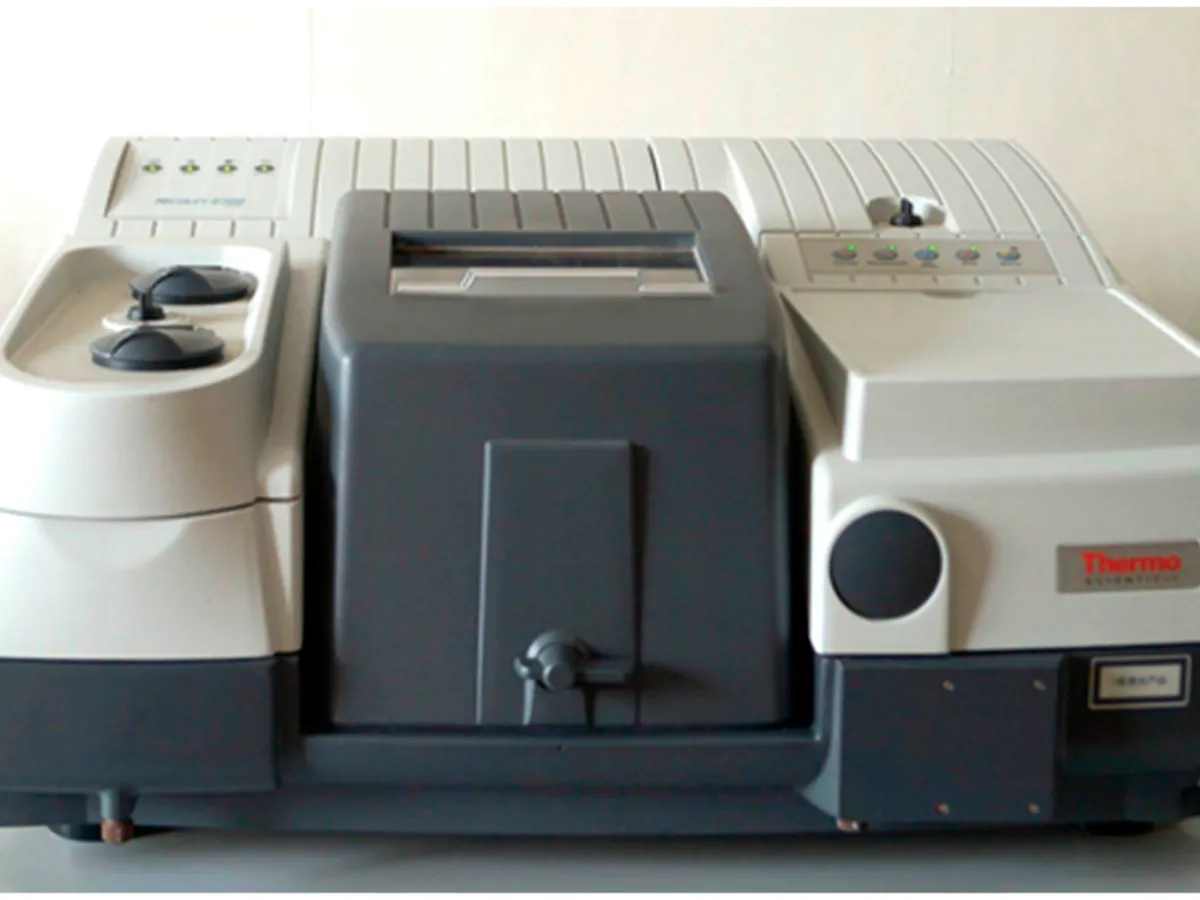
Fourier Transform Infrared (FTIR) Spectrometer
Records the infrared absorption spectrum of a sample, which acts as a molecular fingerprint. The standard technique for identification of APIs and excipients in pharma QC.
- Pharmaceutical
- Polymers & plastics
- Chemicals
- Forensics
- Food
- Academic research
Test your FTIR knowledge
Multiple-choice questions
Pick an answer to see whether you are right and why.
Q1. In which unit is the x-axis of an FTIR spectrum usually expressed?
basicQ2. Which part of an FTIR replaces the monochromator of a dispersive instrument?
basicQ3. Which material is used to prepare discs for transmission IR spectra of solids?
basicQ4. Which standard is used to check the wavenumber accuracy of an FTIR?
intermediateQ5. A broad band near 3400 cm⁻¹ and a band near 1640 cm⁻¹ appear in every KBr-disc spectrum. The most likely cause is:
intermediateQ6. What is the main advantage of the ATR technique?
intermediateQ7. Why is a background spectrum collected before measuring a sample?
advancedQ8. The IR spectrum of a raw material differs from the reference standard, but other tests indicate it is the correct substance. What is a likely explanation the monograph may address?
advanced
Viva questions
Think of your answer first, then open it to compare.
1. Why is IR called a 'fingerprint' technique?
The pattern of bands below about 1500 cm⁻¹ comes from complex vibrations of the whole molecule and is unique to each compound, much like a fingerprint. Two different compounds almost never give identical spectra, which makes IR the preferred identification test in pharmacopoeias.
2. Compare the ATR and KBr disc techniques.
KBr disc: the sample is ground with dry KBr and pressed into a transparent disc; it gives a classic transmission spectrum but needs skill, dry conditions and time, and moisture or ion exchange can affect it. ATR: the sample is pressed onto a crystal and an evanescent wave samples a thin surface layer; it is quick and easy, but band intensities at low wavenumbers are relatively stronger. Sample and reference must be measured by the same technique.
3. What are the advantages of FTIR over a dispersive IR instrument?
All wavelengths are measured at once (multiplex advantage), so spectra are fast and many scans can be averaged for good signal-to-noise. There are no slits limiting the light (throughput advantage). The reference laser tracks mirror position, giving very accurate wavenumbers (Connes advantage).
4. Which checks are part of FTIR calibration and how is each done?
Wavenumber accuracy: record a certified polystyrene film and compare band positions with reference values within typical tolerances of about ±1 to ±2 cm⁻¹. Resolution: compare the absorbance at polystyrene maxima and nearby minima (for example near 2849.5/2870 and 1583/1589 cm⁻¹) against the chapter's minimum differences. Signal-to-noise: ratio two backgrounds to make a 100% line, measure the noise in a band-free region and compare the S/N with the manufacturer's specification.
Keep every FTIR in control: usage logs, calibration and maintenance schedules, and automatic blocking of overdue instruments.