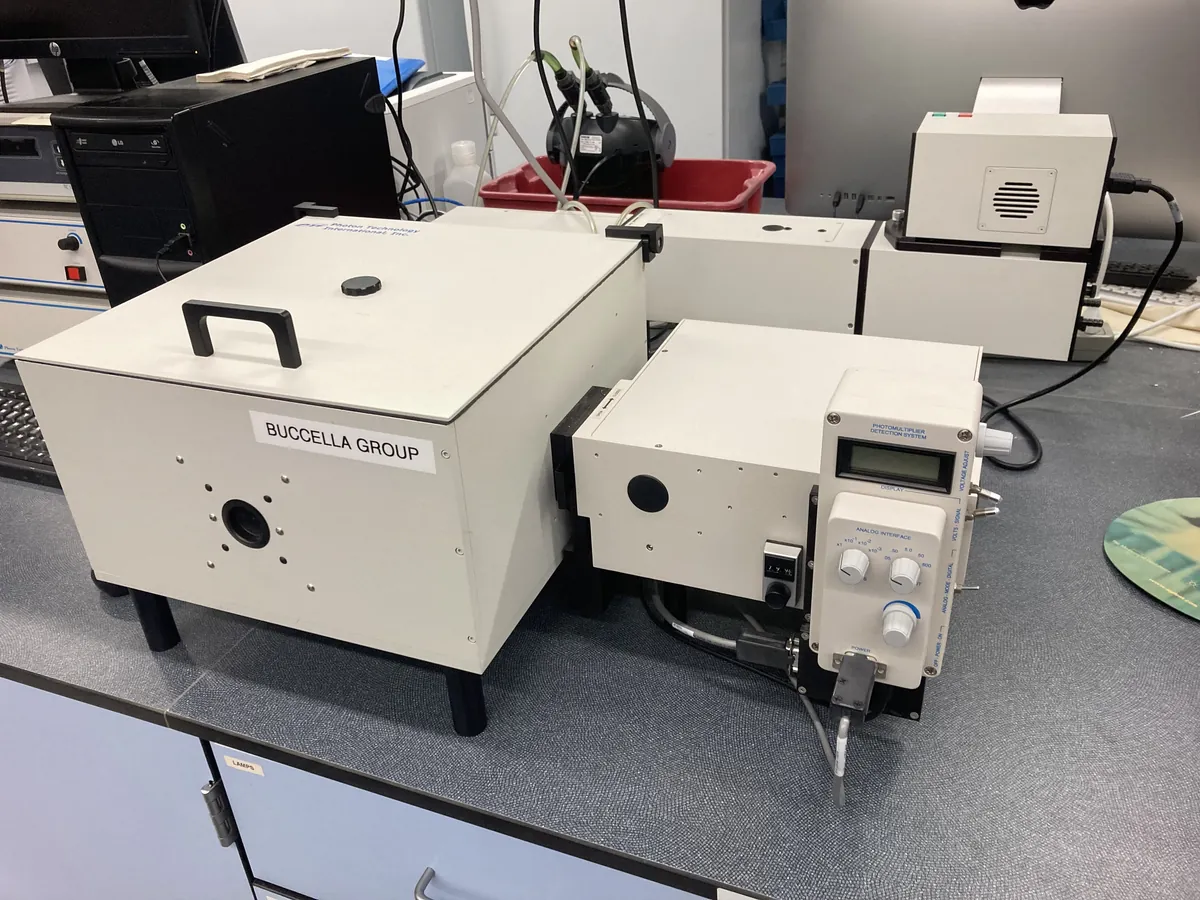
Fluorescence Spectrophotometer (Spectrofluorometer)
Shines light of one wavelength on a sample and measures the longer-wavelength light the molecules give back (fluorescence). Very sensitive and selective for fluorescent compounds.
- Pharmaceutical
- Biotech
- Clinical
- Environmental
- Food & beverage
- Research
Test your Fluorimeter knowledge
Multiple-choice questions
Pick an answer to see whether you are right and why.
Q1. Why is fluorescence measured at 90° to the excitation beam?
basicQ2. Compared with the excitation wavelength, fluorescence emission occurs at:
basicQ3. What type of cuvette is needed for fluorescence?
basicQ4. The calibration curve bends downwards at high concentrations. The likely cause is:
intermediateQ5. With 350 nm excitation, the water Raman band appears at about:
intermediateQ6. Which of these commonly quenches fluorescence?
intermediateQ7. Raman peak = 60,000 cps, background = 900 cps. Using S/N = (peak − background) ÷ √background, what is S/N?
advanced
Viva questions
Think of your answer first, then open it to compare.
1. Why is fluorescence usually more sensitive than UV-Vis absorbance?
Absorbance measures a small decrease in a bright beam, which is limited by noise in that beam. Fluorescence measures emitted light against a nearly dark background, and the signal can be increased with lamp intensity and detector gain.
2. How do you tell a Raman band from a real fluorescence peak in a blank?
Change the excitation wavelength. A Raman band moves with the excitation (fixed energy shift), while a true fluorescence peak stays at the same emission wavelength.
3. Why must fluorescence results always be quantified against standards?
Fluorescence intensity is in arbitrary units that depend on lamp output, slits, PMT voltage, geometry, temperature and solvent. There is no absolute constant like molar absorptivity that transfers between instruments, so standards measured under the same conditions are essential.
Keep every Fluorimeter in control: usage logs, calibration and maintenance schedules, and automatic blocking of overdue instruments.