Fluorescence Spectrophotometer (Spectrofluorometer)
Shines light of one wavelength on a sample and measures the longer-wavelength light the molecules give back (fluorescence). Very sensitive and selective for fluorescent compounds.
- Pharmaceutical
- Biotech
- Clinical
- Environmental
- Food & beverage
- Research
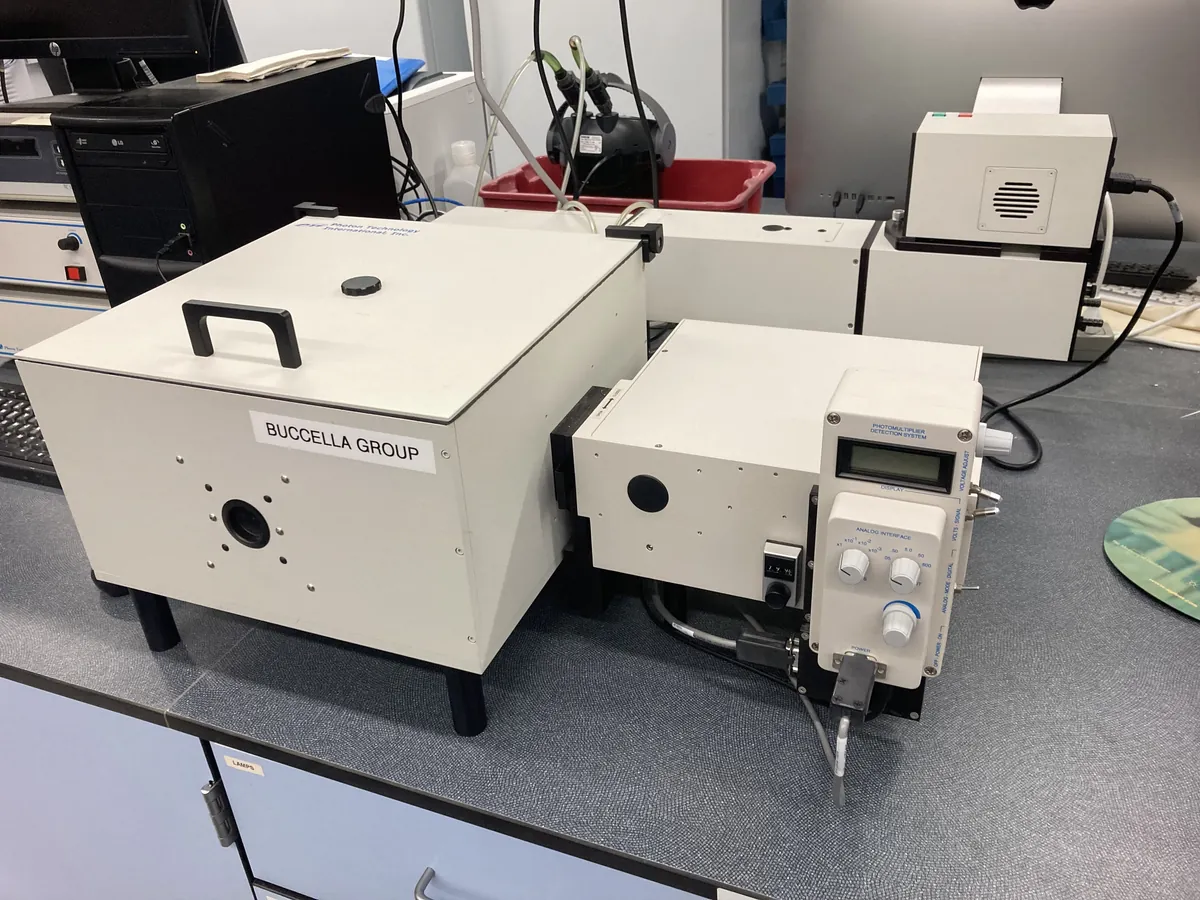
What is Fluorimeter?
Some molecules absorb light and then re-emit part of the energy as light of a longer wavelength within nanoseconds. This is fluorescence. A fluorescence spectrophotometer selects an excitation wavelength with one monochromator, shines it on the sample, and measures the emitted light at 90° to the beam through a second monochromator.
Because the instrument measures light against a dark background instead of a small drop in a bright beam (as in UV-Vis), fluorescence is often 10 to 1000 times more sensitive than absorbance. It is also more selective, because both the excitation and the emission wavelengths must match the compound.
In pharma, fluorescence is used for assays of naturally fluorescent drugs (for example some vitamins, quinine and certain antibiotics), dissolution of low-dose products, derivatised analytes, and in biotech for protein and DNA assays. It is also the basis of fluorescence detectors for HPLC.
Used for
- Assay of fluorescent drugs at low concentration (e.g. riboflavin, quinine)
- Dissolution testing of low-strength products
- Assays after derivatisation with a fluorescent tag
- Protein, nucleic acid and cell-based assays in biotech
- Identification by excitation and emission spectra
How it works
- 01
Light source
A xenon arc or flash lamp gives a continuous spectrum from UV to visible.
- 02
Excitation monochromator
Selects the excitation wavelength (λex) that the analyte absorbs.
- 03
Sample cell
A four-side-polished quartz cuvette holds the sample; fluorescence comes out in all directions.
- 04
Emission monochromator
Placed at 90° to the excitation beam to avoid the transmitted light; selects the emission wavelength (λem).
- 05
Detector
A photomultiplier tube measures the weak emitted light; a reference detector corrects for lamp fluctuation.
Advantages
- Very high sensitivity (ng/mL or lower for strong fluorophores)
- Two wavelengths give high selectivity
- Small sample volumes
- Non-destructive measurement
Limitations
- Only works for fluorescent compounds or those that can be derivatised
- Inner-filter effect and quenching make the response non-linear at higher concentrations
- Sensitive to temperature, pH, solvent and dissolved oxygen
- Signal is in arbitrary units and differs between instruments, so standards are always needed
- Raman and Rayleigh scatter from the solvent can overlap the emission
2 calibration procedures
Keep every Fluorimeter in control: usage logs, calibration and maintenance schedules, and automatic blocking of overdue instruments.