Spectroscopy
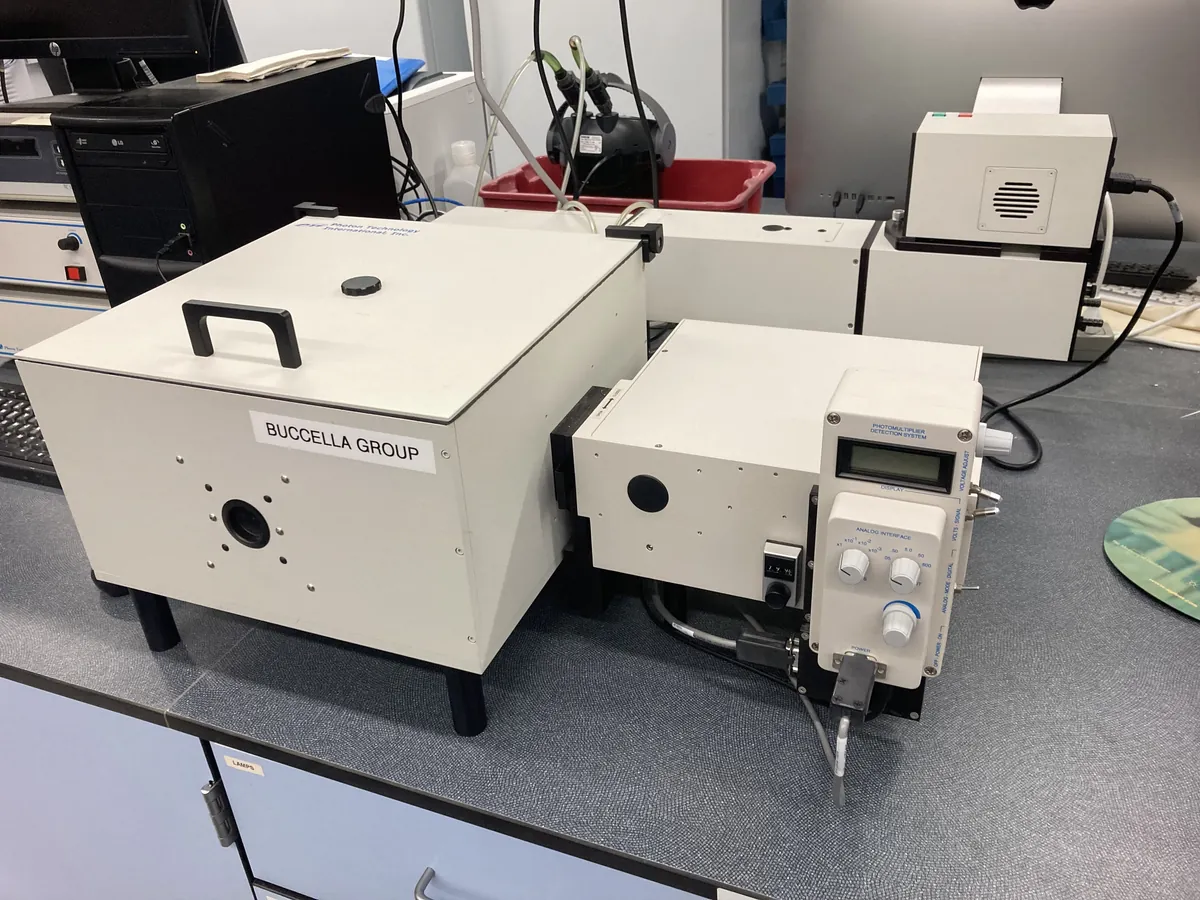
Fluorescence Spectrophotometer (Spectrofluorometer)
Shines light of one wavelength on a sample and measures the longer-wavelength light the molecules give back (fluorescence). Very sensitive and selective for fluorescent compounds.
- Pharmaceutical
- Biotech
- Clinical
- Environmental
- Food & beverage
- Research
Follow your site SOP
This is a typical operating sequence for learning. Your instrument model and approved SOP take precedence.
STAGE 1
Before you start
- 1Check calibration status and log book.
- 2Switch on the lamp and allow it to stabilise (often 15–30 minutes for a continuous xenon lamp).
- 3Use clean four-side-polished quartz cuvettes; handle them by the frosted edges only.
- Never open the lamp housing while it is on; xenon lamps run at high pressure and emit strong UV.
STAGE 2
Set-up
- 1Set excitation and emission wavelengths and slit widths from the method.
- 2Set PMT voltage so the highest standard is on scale and not saturated.
- 3Measure the solvent blank and check for Raman or impurity peaks near the emission wavelength.
- Avoid setting the emission wavelength at twice the excitation wavelength, where second-order scatter appears.
STAGE 3
Measurement
- 1Measure the blank, then standards from low to high to build the calibration curve.
- 2Measure samples, re-measuring a check standard regularly to confirm stability.
- 3Keep sample temperature constant; fluorescence intensity usually falls as temperature rises.
- Dilute samples whose absorbance is high to avoid inner-filter effects.
STAGE 4
Shutdown
- 1Rinse cuvettes with solvent and store them dry and covered.
- 2Switch off the lamp and allow the fan to cool it before switching off the main power, if the manual says so.
- 3Record lamp hours and usage in the log book.
In LimsPulse · Calibration Management
Keep every Fluorimeter in control: usage logs, calibration and maintenance schedules, and automatic blocking of overdue instruments.