Disintegration Test Apparatus
Checks whether tablets or capsules break up within a stated time when moved up and down in a liquid at 37 °C. A quick, routine test for release and in-process control.
- Pharmaceutical
- Nutraceuticals and dietary supplements
- Veterinary medicines
- Contract testing labs
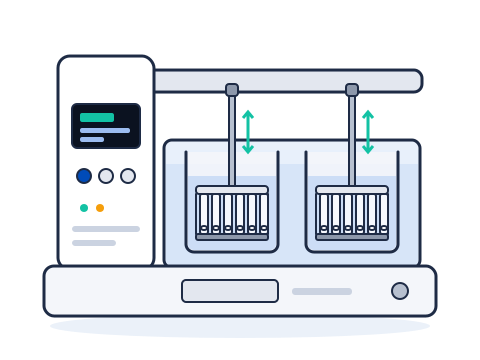
What is Disintegration tester?
The disintegration tester raises and lowers a basket-rack assembly in a beaker of immersion fluid, usually water or a buffer, at 37 °C. The rack has six open-ended tubes with a wire-mesh floor, one dosage unit per tube.
The test passes when every unit has disintegrated within the time stated in the monograph. Disintegration does not mean the unit has dissolved: it means no firm core remains on the mesh, only a soft mass or fragments of coating or capsule shell.
It is used for batch release of tablets and capsules, as an in-process check during compression and coating, and for enteric-coated products where the unit must resist acid and then disintegrate in buffer.
Used for
- Uncoated, film-coated and sugar-coated tablets
- Hard and soft gelatin capsules
- Enteric-coated (gastro-resistant) tablets and capsules
- Dispersible, effervescent and orodispersible tablets (per their own monograph conditions)
- In-process control during compression and coating
How it works
- 01
Fill beaker
Fill the 1 L beaker with the specified immersion fluid and bring it to 37 ± 2 °C.
- 02
Load units
Place one unit in each of the six tubes; add discs if the monograph requires.
- 03
Start strokes
Start the drive so the rack moves up and down at a constant rate over a fixed distance.
- 04
Observe
Watch the units and note when each has disintegrated.
- 05
Judge
At the stated time, check that all units have disintegrated; apply the repeat rule if one or two fail.
Advantages
- Simple, fast and inexpensive
- Six units tested at once
- Useful in-process check that flags over-compression or poor coating early
- Standardised apparatus in all major pharmacopoeias
Limitations
- Pass or fail only; it does not measure how much drug is released
- End-point judgement is visual and partly subjective
- Passing disintegration does not guarantee acceptable dissolution
- Units can stick to the mesh or float, which complicates the reading
2 calibration procedures
Methods that use Disintegration tester
Keep every Disintegration tester in control: usage logs, calibration and maintenance schedules, and automatic blocking of overdue instruments.