Disintegration tester · Calibration procedure
Stroke frequency & distance
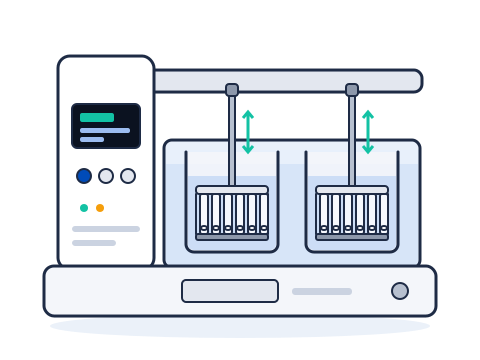
Counts the number of up-and-down cycles per minute and measures the vertical travel of the basket-rack.
PURPOSE
Why this is checked
Both the rate and the length of the stroke control how vigorously the units are agitated, and so affect disintegration time.
Frequency
Typically every 3 to 6 months and after drive maintenance, as defined in your calibration SOP.
Learn how the Disintegration tester worksYOU WILL NEED
Standards & tools
- Calibrated stopwatch
- Calibrated vernier height gauge or steel rule
BEFORE YOU START
Prerequisites
- Basket-rack fitted
- Apparatus running in the normal mode
PROCEDURE
Step by step
- 1Start the apparatus and let it run for a minute to stabilise.
- 2Count the complete up-and-down cycles over 1 minute with the stopwatch (or over 2 minutes and divide by two). Repeat for each station.
- 3Stop the drive at the lowest point and measure the height of a fixed point on the rack.
- 4Move the drive to the highest point and measure the same point again.
- 5Stroke distance = highest minus lowest position.
RECORD
Example observation table
| Station | Cycles in 1 min | Lowest position (mm) | Highest position (mm) | Stroke (mm) |
|---|---|---|---|---|
| A | 30 | 12.0 | 67.2 | 55.2 |
| B | 31 | 12.5 | 67.4 | 54.9 |
CALCULATION
How to calculate the result
Stroke distance = Highest position − Lowest position
- Station A: 67.2 − 12.0 = 55.2 mm (within 53–57 mm)
- Frequency 30 cycles/min (within 29–32)
ACCEPTANCE CRITERIA
Pass if
- Frequency: typically 29–32 cycles per minute.
- Stroke distance: typically 53–57 mm.
- Check the current chapter and your SOP for exact limits.
IF IT FAILS
What to do
- Label the apparatus out of calibration
- Service the drive and recalibrate
- Assess the impact on results since the last pass
MORE
Other Disintegration tester calibrations
In LimsPulse · Calibration Management
LimsPulse schedules this calibration, records the result against limits, and blocks the instrument everywhere if it fails or goes overdue.