Dosage-form testing
Disintegration Test Apparatus
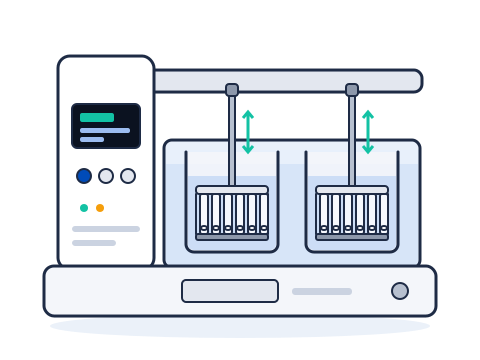
Checks whether tablets or capsules break up within a stated time when moved up and down in a liquid at 37 °C. A quick, routine test for release and in-process control.
- Pharmaceutical
- Nutraceuticals and dietary supplements
- Veterinary medicines
- Contract testing labs
TROUBLESHOOTING
Common problems, causes and fixes
Disintegration time longer than usual
Likely causes
- • Fluid temperature low
- • Stroke rate slow
- • Product hardness higher than usual (compression force)
- • Wrong or old immersion fluid
What to do
- • Check temperature and stroke rate
- • Review in-process hardness data
- • Prepare fresh fluid
Fragments pass through too quickly (false pass)
Likely causes
- • Torn or enlarged mesh
- • Wrong mesh fitted
What to do
- • Replace the mesh with one of the correct aperture and check it against the drawing
Units float or stick to the mesh
Likely causes
- • Air trapped in capsules
- • Sticky coating or soft gelatin
What to do
- • Use discs only if the monograph allows
- • Record the observation and follow the monograph instructions for that dosage form
Rack movement uneven or noisy
Likely causes
- • Worn drive or loose arm
- • Rack not hung correctly
What to do
- • Re-seat the rack
- • Service the drive and recalibrate the stroke
Temperature not stable
Likely causes
- • Low bath level
- • Heater or sensor fault
What to do
- • Top up the bath
- • Check against a calibrated thermometer and service the heater
In LimsPulse · Calibration Management
Keep every Disintegration tester in control: usage logs, calibration and maintenance schedules, and automatic blocking of overdue instruments.