Disintegration Time of Tablets and Capsules
Checks that six dosage units break up completely within a stated time when moved up and down in fluid at 37 °C.
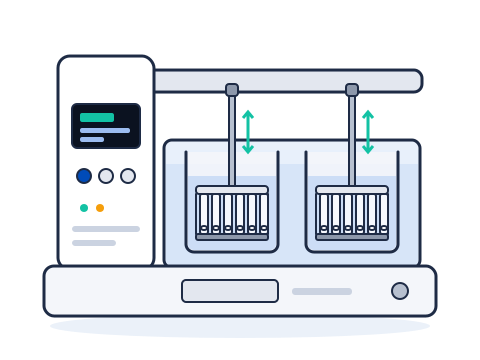
- Disintegration tester (basket-rack assembly)
- Disintegration tester
Reference: Typical procedure based on pharmacopoeial disintegration chapters. Use the immersion fluid, time limit and disc requirement in your monograph or specification.
Why this method works
The units are agitated by the vertical movement of the basket-rack in water or another specified fluid at body temperature. Water penetrates the unit, disintegrants swell and the unit breaks into particles that pass through the mesh. The test passes when no firm core remains on the mesh within the time limit.
Instruments used
Reagents & standards
| Reagent | Grade / specification |
|---|---|
| Immersion fluid | Purified water, or the fluid stated in the monograph (e.g. 0.1 M hydrochloric acid or simulated gastric fluid; phosphate buffer pH 6.8 for the second stage of enteric-coated products) |
| Discs | Only if the monograph specifies them |
Preparing the sample
- 01
Prepare fluid
Fill the beaker with the specified fluid and bring it to 37 ± 2 °C.
- 02
Load units
Place one unit in each of the six tubes.
- 03
Run
Start the apparatus and the timer together.
- 04
Observe
Watch the units and record when each disintegrates.
- 05
Judge
Compare with the time limit and apply the repeat rule if needed.
Procedure
- 1Fill the beaker with the immersion fluid and allow it to reach 37 ± 2 °C; check the temperature with a calibrated thermometer.
- 2Check the mesh is intact and the rack is hung correctly.
- 3Place one tablet or capsule in each of the six tubes. Add discs only if the monograph requires them.
- 4Start the apparatus and the timer.
- 5At the end of the stated time, lift the basket from the fluid and observe each tube.
- 6Record whether each unit has completely disintegrated, and the time if the instrument records individual end-points.
Notes for analysts
- Disintegration is not the same as dissolution. A tablet can pass disintegration and still fail dissolution.
- Over-compressed tablets, high binder levels or ageing of coatings can increase disintegration time.
- Record the time for each unit when possible; trends are useful even when the batch passes.
- For orodispersible, dispersible and effervescent tablets, follow the specific conditions in their monographs.
Method parameters (typical)
| Apparatus | Basket-rack assembly with six tubes |
|---|---|
| Fluid volume | Enough that the mesh stays at least 15 mm below the surface at the top of the stroke (typically 800–900 mL in a 1 L beaker) |
| Temperature | 37 ± 2 °C |
| Stroke | About 53–57 mm at 29–32 cycles per minute |
| Typical time limits | Commonly 15 minutes for uncoated tablets, 30 minutes for film-coated tablets and hard capsules; check the monograph |
| Enteric-coated units | No disintegration or cracking in acid for the stated period (often 2 hours), then disintegration in pH 6.8 buffer within the stated time (often 60 minutes) |
System suitability & sequence
| Parameter | Limit |
|---|---|
| Apparatus calibration | Stroke frequency, distance and temperature within due date |
| Fluid temperature | 37 ± 2 °C at start of the test |
Typical sequence
- 1Check apparatus and temperature
- 2Run six units
- 3Repeat with twelve more units only if one or two units fail
What result passes
- All six units disintegrate completely within the stated time.
- If one or two units fail, test twelve more; the requirement is met if not fewer than 16 of the 18 units disintegrate (as described in USP <701>; check your pharmacopoeia).
- Complete disintegration: any residue left on the mesh is a soft mass with no firm core, or fragments of insoluble coating or capsule shell.
Validation parameters (ICH Q2(R2))
| Parameter | Typical requirement |
|---|---|
| Applicability | Pharmacopoeial test; verify that the product behaves suitably (e.g. no sticking or floating issues that need discs) during development |
| Precision | Consistent results across analysts on a reference batch |
Run this method in LimsPulse: specifications and STPs under version control, results calculated and checked against limits, and a signed Certificate of Analysis.