Disintegration Test Apparatus
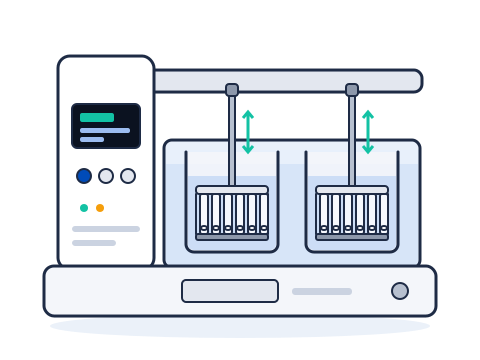
Checks whether tablets or capsules break up within a stated time when moved up and down in a liquid at 37 °C. A quick, routine test for release and in-process control.
- Pharmaceutical
- Nutraceuticals and dietary supplements
- Veterinary medicines
- Contract testing labs
Test your Disintegration tester knowledge
Multiple-choice questions
Pick an answer to see whether you are right and why.
Q1. How many tubes does a standard basket-rack assembly have?
basicQ2. The typical immersion fluid temperature for disintegration is:
basicQ3. The basket-rack typically moves at:
intermediateQ4. Two of six tablets have not disintegrated in time. What is the next step under USP <701>?
intermediateQ5. Which residue on the mesh is still counted as complete disintegration?
intermediateQ6. An enteric-coated tablet is tested first in acid. What should happen during the acid stage?
advanced
Viva questions
Think of your answer first, then open it to compare.
1. What is the difference between disintegration and dissolution?
Disintegration is the physical break-up of the unit into small particles; it is pass or fail and does not measure drug in solution. Dissolution measures how much drug has gone into solution over time. A tablet can disintegrate quickly and still dissolve slowly.
2. When are discs used, and why not always?
Discs are used only when the monograph specifies them, for example to stop units floating. They add mechanical force, so using them when not specified can make a borderline batch pass.
3. What would you check if disintegration time suddenly increases for a routine product?
Check the apparatus (temperature, stroke rate and distance, mesh condition) and the fluid. Then review the batch: compression force and hardness, granule moisture, binder level, coating thickness and storage conditions.
Keep every Disintegration tester in control: usage logs, calibration and maintenance schedules, and automatic blocking of overdue instruments.