Curing Tank (Water Curing Tank)
A temperature-controlled water tank in which concrete cubes, cylinders and mortar cubes are stored until testing so they gain strength under standard conditions.
- Construction materials testing
- Ready-mix concrete plants
- Precast concrete
- Cement plants
- Construction sites
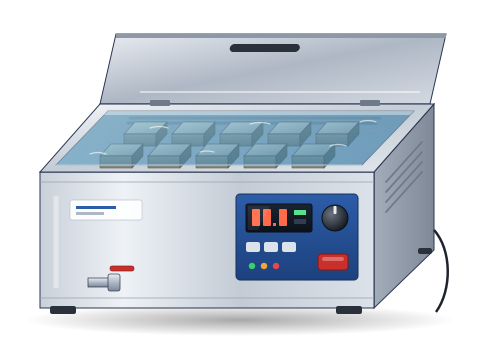
What is Curing tank?
Concrete and mortar gain strength by hydration, which needs water and depends strongly on temperature. To compare strength results fairly, test specimens must be cured under standard conditions. After demoulding (usually at about 24 hours), specimens are placed in a curing tank of clean water held at a set temperature until they are tested.
IS 516 typically requires curing water at 27 ± 2 °C. ASTM practices (C511 and C31 / C192) use 23 ± 2 °C and require the water to be saturated with calcium hydroxide (hydrated lime) so that lime does not leach out of the specimens. Labs follow whichever standard applies to the job.
A lab tank is usually a stainless-steel or plastic-lined tank with an immersion heater, sometimes a chiller, a circulation pump and a digital controller. The tank's temperature is checked daily and logged, and its uniformity is verified periodically.
Used for
- Curing concrete cubes and cylinders for 7- and 28-day strength
- Curing cement mortar cubes after the first 24 hours in a moist cabinet
- Curing specimens for flexural, split-tensile and durability tests
- Accelerated curing in special hot-water tanks (separate methods)
How it works
- 01
Demoulding
Specimens are removed from moulds after about 24 hours and marked with an ID.
- 02
Immersion
They are placed in the tank, fully covered with water, with space around each for circulation.
- 03
Temperature control
A heater (and chiller, if fitted) controlled by a sensor keeps the water at the set point.
- 04
Circulation
A pump or stirrer mixes the water to avoid hot and cold zones.
- 05
Monitoring
Temperature is recorded at least daily or logged continuously.
- 06
Removal
Specimens are taken out just before testing and tested in a wet condition.
Advantages
- Simple and reliable way to give standard curing
- Large capacity for many specimens
- Digital control and logging give traceable records
- Water is a good heat-transfer medium, so specimens follow the set temperature closely
Limitations
- Temperature can stratify without circulation
- Water quality must be maintained (algae, sediment, lime saturation)
- Power failures can cause temperature excursions
- Heavy; needs a strong floor and drainage
1 calibration procedure
Methods that use Curing tank
Keep every Curing tank in control: usage logs, calibration and maintenance schedules, and automatic blocking of overdue instruments.