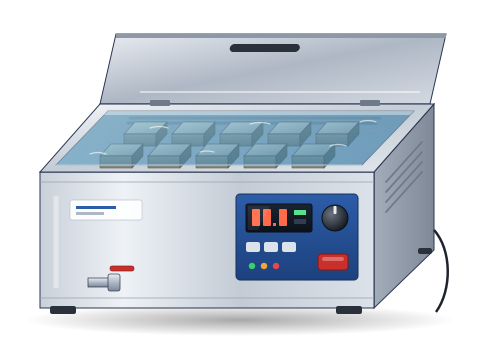
Curing Tank (Water Curing Tank)
A temperature-controlled water tank in which concrete cubes, cylinders and mortar cubes are stored until testing so they gain strength under standard conditions.
- Construction materials testing
- Ready-mix concrete plants
- Precast concrete
- Cement plants
- Construction sites
Test your Curing tank knowledge
Multiple-choice questions
Pick an answer to see whether you are right and why.
Q1. What curing water temperature does IS 516 typically require?
basicQ2. Why do ASTM practices require the curing water to be saturated with hydrated lime?
basicQ3. A multi-point check gives readings from 26.5 to 29.4 °C. For IS 516 curing, the tank:
intermediateQ4. What is the most likely cause of a large difference between top and bottom temperatures?
intermediateQ5. Cubes cured at 32 °C for a week instead of 27 °C would most likely show:
advanced
Viva questions
Think of your answer first, then open it to compare.
1. Why is curing temperature controlled for test specimens?
Strength gain depends on time and temperature. Standard curing temperature makes strength results comparable between labs and over time, so they reflect the concrete, not how it was stored.
2. How would you carry out a water temperature check of a curing tank?
With the tank running at set point, place a calibrated thermometer or logger probes at several positions and levels (e.g. nine points), record readings and the controller display, apply certificate corrections, and confirm every point is within 27 ± 2 °C (IS) or 23 ± 2 °C (ASTM) and that the display agrees with the reference.
Keep every Curing tank in control: usage logs, calibration and maintenance schedules, and automatic blocking of overdue instruments.