Curing Tank (Water Curing Tank)
A temperature-controlled water tank in which concrete cubes, cylinders and mortar cubes are stored until testing so they gain strength under standard conditions.
- Construction materials testing
- Ready-mix concrete plants
- Precast concrete
- Cement plants
- Construction sites
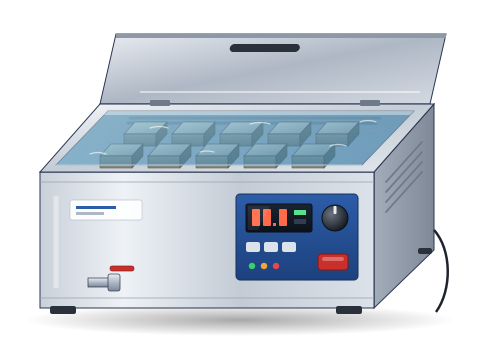
How Curing tank works
Cement hydration needs water and proceeds faster at higher temperature. Keeping specimens fully immersed in water at a controlled temperature gives a repeatable rate of strength gain, so strength results reflect the material rather than storage conditions.
The path of a sample
- 01
Demoulding
Specimens are removed from moulds after about 24 hours and marked with an ID.
- 02
Immersion
They are placed in the tank, fully covered with water, with space around each for circulation.
- 03
Temperature control
A heater (and chiller, if fitted) controlled by a sensor keeps the water at the set point.
- 04
Circulation
A pump or stirrer mixes the water to avoid hot and cold zones.
- 05
Monitoring
Temperature is recorded at least daily or logged continuously.
- 06
Removal
Specimens are taken out just before testing and tested in a wet condition.
Main parts and what they do
Tank body
Corrosion-resistant tank (stainless steel or lined) holding the water and specimens.
Immersion heater
Warms the water to the set point.
Chiller (optional)
Cools the water in hot climates where room temperature exceeds the set point.
Circulation pump or stirrer
Mixes the water to keep the temperature even.
Temperature controller and sensor
Controls the heater / chiller and displays the water temperature.
Data logger or chart recorder
Records temperature continuously for traceability.
Specimen racks
Keep specimens off the bottom so water circulates around them.
Terms every analyst should know
Standard curing temperature
Typically 27 ± 2 °C under IS 516 and 23 ± 2 °C under ASTM practices.
Lime-saturated water
ASTM practices require water saturated with calcium hydroxide to stop lime leaching from specimens.
Maturity
Strength gain depends on both time and temperature; warmer curing means faster early strength.
Temperature uniformity
Every point in the tank, not just the controller sensor, must be within the tolerance.
Keep every Curing tank in control: usage logs, calibration and maintenance schedules, and automatic blocking of overdue instruments.