Construction materials testing
Curing Tank (Water Curing Tank)
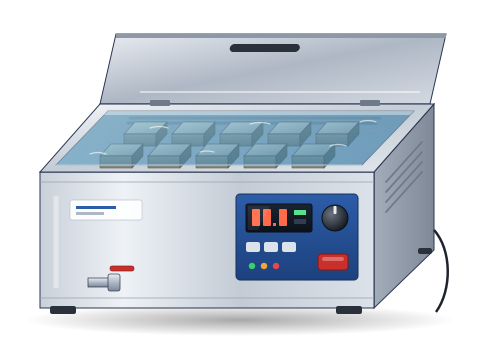
A temperature-controlled water tank in which concrete cubes, cylinders and mortar cubes are stored until testing so they gain strength under standard conditions.
- Construction materials testing
- Ready-mix concrete plants
- Precast concrete
- Cement plants
- Construction sites
Follow your site SOP
This is a typical operating sequence for learning. Your instrument model and approved SOP take precedence.
STAGE 1
Before you start
- 1Check the water level covers all specimen positions with margin.
- 2Check the displayed temperature and the reference thermometer reading are within limits.
- 3For ASTM work, check that the water is saturated with hydrated lime.
- Do not overload the tank; blocked circulation causes uneven temperature.
STAGE 2
Loading specimens
- 1Mark each specimen with a waterproof ID (sample, date cast, age).
- 2Place specimens on racks with gaps between them, fully submerged.
- 3Record the date and time each specimen enters the tank in the curing register or LIMS.
- Lower specimens gently; dropping them can cause micro-cracks.
STAGE 3
Daily monitoring
- 1Read and record the water temperature at least once a day (or review the data logger).
- 2Check the water is clean and the circulation pump is running.
- 3Top up with water at the same temperature (and lime-saturated for ASTM) if the level falls.
- Investigate and record any excursion outside the tolerance, and assess affected specimens.
STAGE 4
Removing specimens
- 1Remove specimens just before testing and keep them wet until tested.
- 2Wipe off surface water and grit before placing in the testing machine.
In LimsPulse · Calibration Management
Keep every Curing tank in control: usage logs, calibration and maintenance schedules, and automatic blocking of overdue instruments.