Centrifuge
Spins tubes at high speed so that the centrifugal force separates solids from liquids or liquids of different density. In QC it is used to clarify sample extracts and separate phases.
- Pharmaceutical
- Biotech
- Clinical laboratories
- Food & dairy
- Research
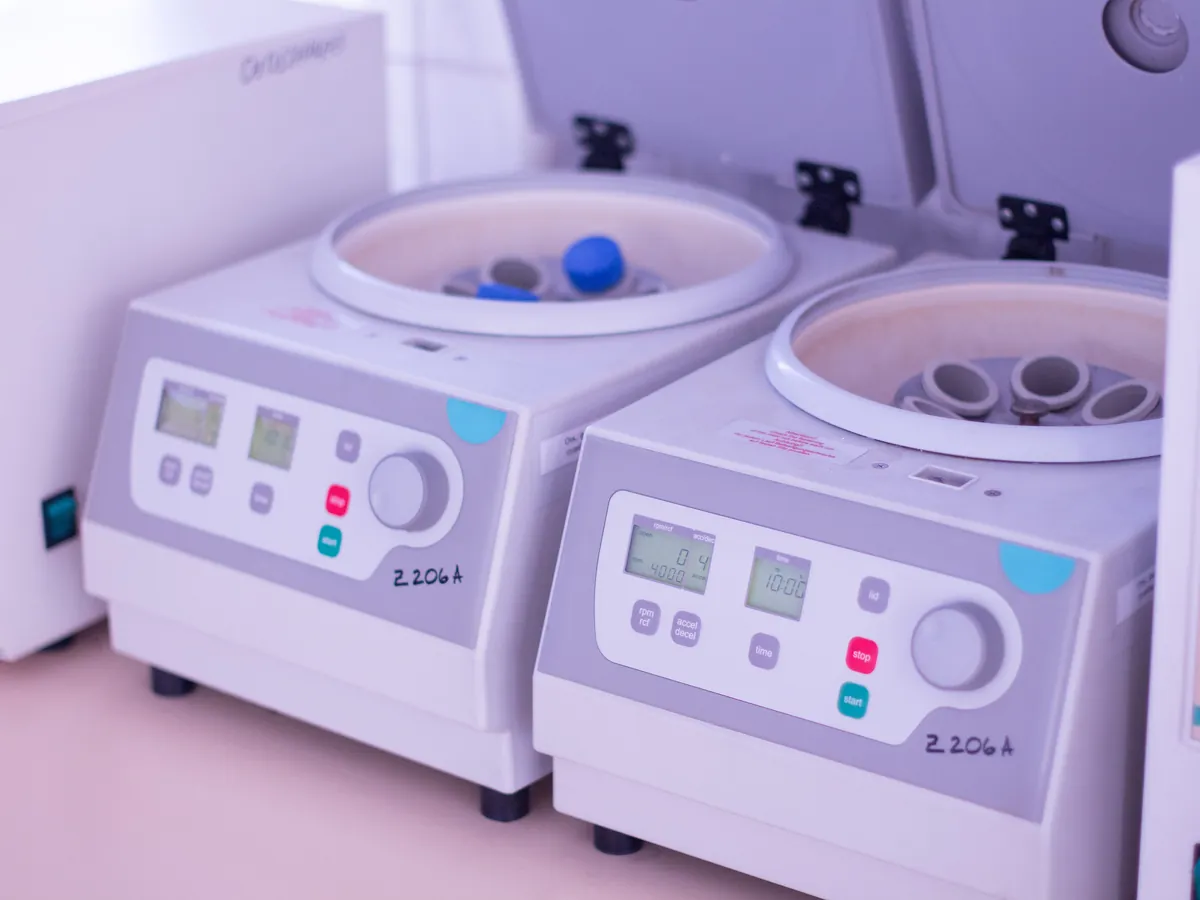
What is Centrifuge?
A centrifuge spins samples around a central axis. The spinning creates a force many times stronger than gravity, so denser particles move outwards and settle at the bottom of the tube while the clear liquid (supernatant) stays on top.
The separating force is expressed as relative centrifugal force (RCF), in multiples of gravity (× g). RCF depends on both the speed (rpm) and the radius of the rotor, so methods should state RCF rather than rpm. RCF = 1.118 × 10⁻⁵ × r × rpm², with r in cm.
In a pharma QC lab, centrifuges clarify cloudy sample solutions before HPLC or UV, separate layers in liquid–liquid extractions, and pellet cells or particles in microbiology. Refrigerated models keep temperature-sensitive samples cool.
Used for
- Clarifying sample extracts before HPLC or UV analysis
- Separating layers in liquid–liquid extraction
- Separating suspensions, emulsions and creams for testing
- Pelleting cells, proteins or particles in microbiology and biotech
- Sample preparation for bioanalysis
How it works
- 01
Load
Tubes of equal mass are placed opposite each other in the rotor.
- 02
Accelerate
The motor brings the rotor up to the set speed.
- 03
Separate
At constant speed, denser material migrates outwards and forms a pellet or lower layer.
- 04
Decelerate
The brake slows the rotor; a gentle brake avoids disturbing the pellet.
- 05
Recover
The supernatant is carefully decanted or pipetted off.
Advantages
- Much faster than letting particles settle by gravity
- Avoids filter adsorption of the analyte
- Many samples processed at once
- Refrigerated models protect heat-sensitive samples
Limitations
- Imbalanced loads cause vibration and can damage the rotor
- Rotors have a limited life and must be inspected
- Fine colloids may not settle at moderate RCF
- Methods quoted in rpm are not transferable unless the radius is the same
2 calibration procedures
Methods that use Centrifuge
Keep every Centrifuge in control: usage logs, calibration and maintenance schedules, and automatic blocking of overdue instruments.