Centrifuge
Spins tubes at high speed so that the centrifugal force separates solids from liquids or liquids of different density. In QC it is used to clarify sample extracts and separate phases.
- Pharmaceutical
- Biotech
- Clinical laboratories
- Food & dairy
- Research
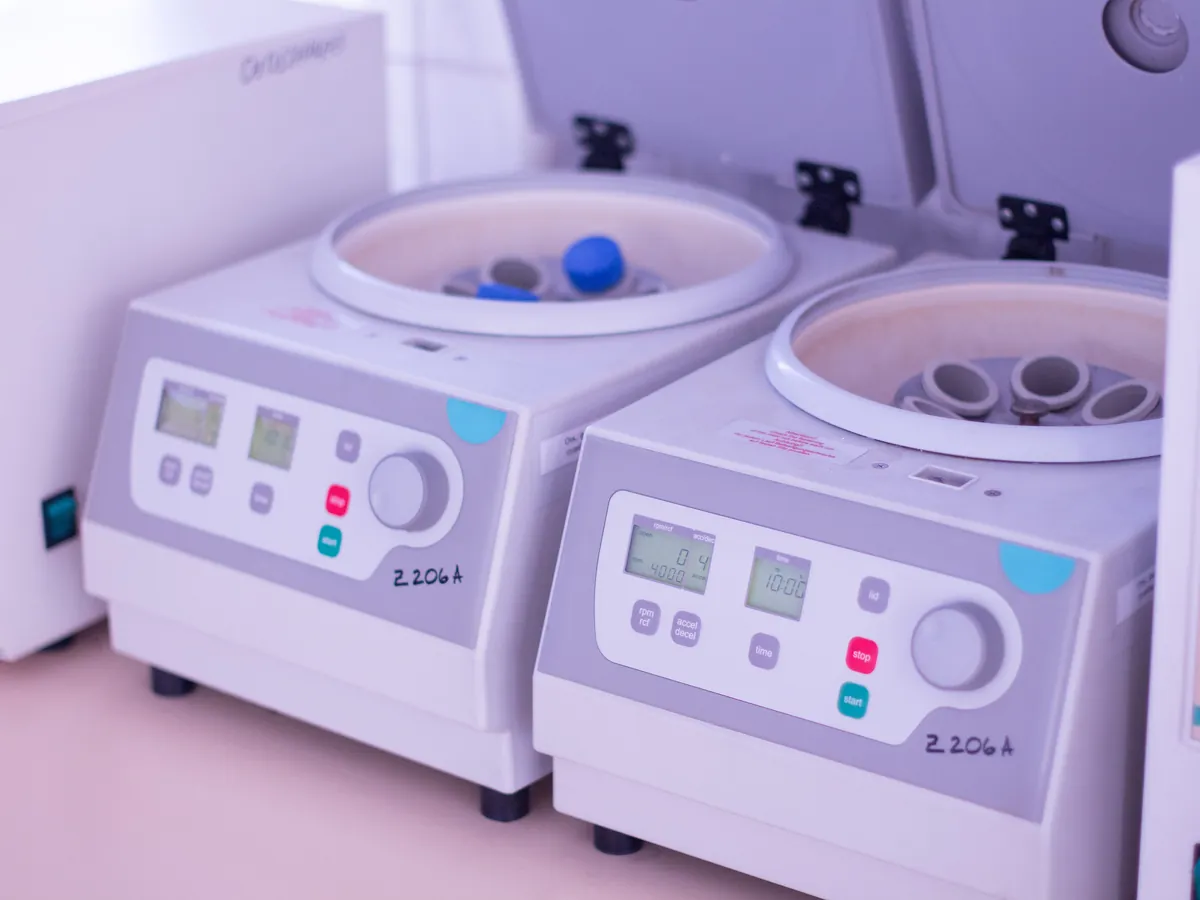
How Centrifuge works
When a tube spins, everything in it is pushed outwards by a centrifugal force proportional to the radius and the square of the speed. Particles denser than the liquid move outwards faster than they would settle under gravity and collect as a pellet.
The path of a sample
- 01
Load
Tubes of equal mass are placed opposite each other in the rotor.
- 02
Accelerate
The motor brings the rotor up to the set speed.
- 03
Separate
At constant speed, denser material migrates outwards and forms a pellet or lower layer.
- 04
Decelerate
The brake slows the rotor; a gentle brake avoids disturbing the pellet.
- 05
Recover
The supernatant is carefully decanted or pipetted off.
Main parts and what they do
Motor and drive
Spins the rotor; usually a brushless induction motor.
Rotor
Fixed-angle or swing-out holder for tubes, rated for a maximum speed.
Buckets and adapters
Hold tubes of different sizes in the rotor.
Lid with interlock
Locks while spinning and cannot open until the rotor stops.
Imbalance detector
Stops the run if the load is out of balance.
Control panel
Sets speed or RCF, time, temperature, acceleration and brake.
Refrigeration (optional)
Cools the chamber for temperature-sensitive samples.
Terms every analyst should know
RCF (× g)
Relative centrifugal force, the separating force as a multiple of gravity. RCF = 1.118 × 10⁻⁵ × r (cm) × rpm².
Worked example
Radius 10 cm at 4000 rpm: RCF = 1.118 × 10⁻⁵ × 10 × 4000² = 1788.8 × g, about 1789 × g.
Fixed-angle vs swing-out rotor
Fixed-angle rotors hold tubes at a set angle and reach high speeds; swing-out rotors let tubes swing horizontal, giving flat pellets.
Balancing
Opposite tubes must have equal mass. Imbalance causes vibration, noise and possible rotor failure.
Rotor maximum speed
Each rotor has a rated maximum speed that must never be exceeded; some rotors are de-rated as they age.
Keep every Centrifuge in control: usage logs, calibration and maintenance schedules, and automatic blocking of overdue instruments.