Centrifuge
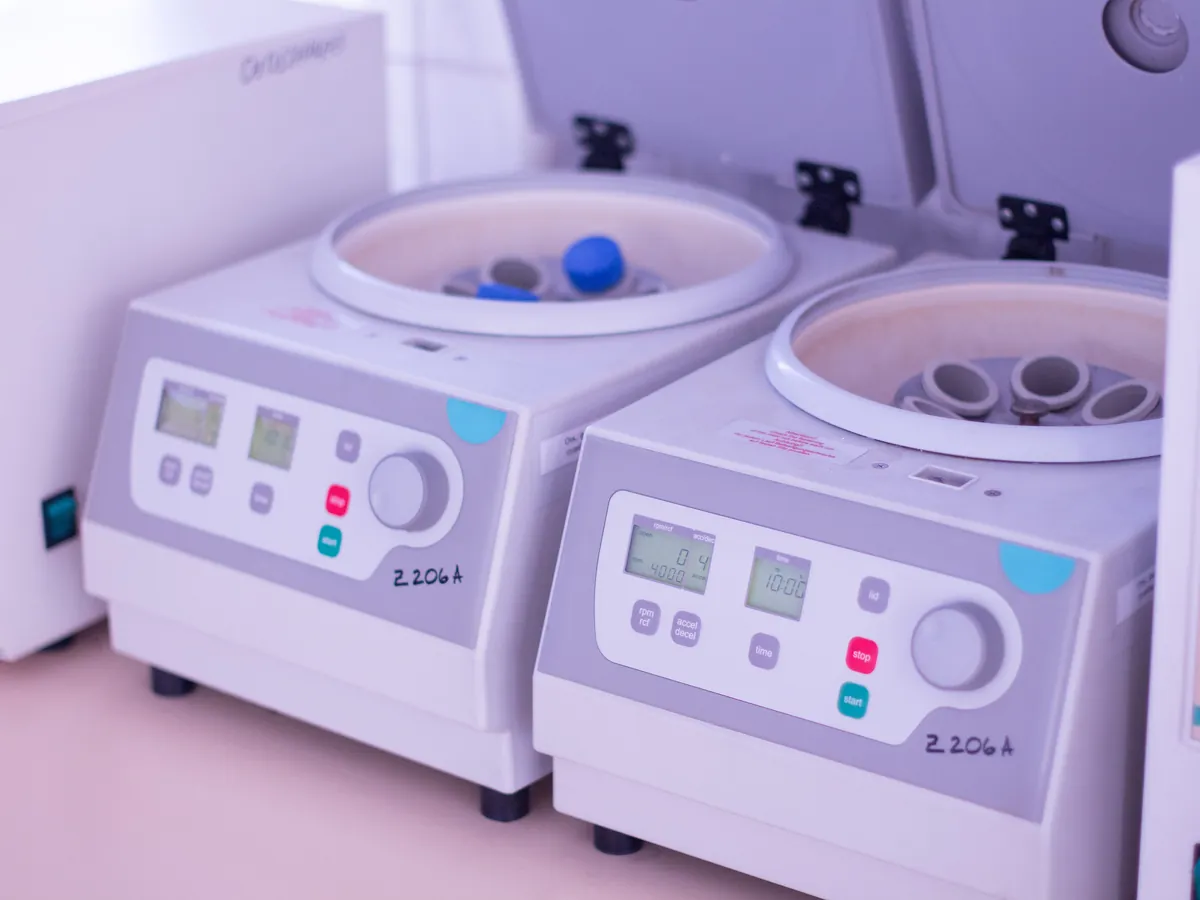
Spins tubes at high speed so that the centrifugal force separates solids from liquids or liquids of different density. In QC it is used to clarify sample extracts and separate phases.
- Pharmaceutical
- Biotech
- Clinical laboratories
- Food & dairy
- Research
Test your Centrifuge knowledge
Multiple-choice questions
Pick an answer to see whether you are right and why.
Q1. What does RCF stand for?
basicQ2. A rotor of radius 10 cm spins at 4000 rpm. What is the RCF? (RCF = 1.118 × 10⁻⁵ × r × rpm²)
intermediateQ3. If the speed of a centrifuge is doubled, the RCF:
intermediateQ4. Which instrument is used to verify centrifuge speed?
basicQ5. The centrifuge vibrates loudly after starting. What should you do first?
basicQ6. Why should a method state RCF instead of rpm?
advanced
Viva questions
Think of your answer first, then open it to compare.
1. How do you balance a centrifuge?
Fill tubes to equal mass (weigh if needed), place them directly opposite each other, and fill empty opposite positions with balance tubes of water of the same mass. Fit all buckets even if empty.
2. What rpm is needed to give 3000 × g with a 15 cm rotor radius?
rpm = √(RCF ÷ (1.118 × 10⁻⁵ × r)) = √(3000 ÷ (1.118 × 10⁻⁵ × 15)) = √17,889,088 ≈ 4230 rpm.
3. Why might a centrifuge be preferred over filtration to clarify an HPLC sample?
Some analytes adsorb onto filter membranes, giving low results, and some filters release extractables. Centrifugation clarifies without contact with a membrane, though it may not remove very fine colloids.
Keep every Centrifuge in control: usage logs, calibration and maintenance schedules, and automatic blocking of overdue instruments.