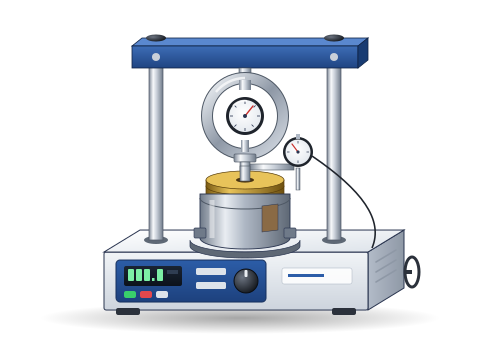
California Bearing Ratio (CBR) Test Apparatus
A load frame that pushes a 50 mm plunger into a compacted soil specimen at 1.25 mm/min and compares the load needed with that for a standard crushed stone. The ratio (CBR) is used to design road and pavement thickness.
- Road and highway construction
- Geotechnical testing
- Airports and railways
- Construction materials testing
- Academic labs
What is CBR apparatus?
The California bearing ratio (CBR) test measures the strength of subgrade soils and granular materials for pavement design. A soil specimen is compacted in a mould (typically 150 mm internal diameter), often soaked in water for four days to represent the worst field condition, and then a cylindrical plunger of about 50 mm diameter is pushed into it at a constant rate of 1.25 mm per minute.
Load is recorded at standard penetrations. The CBR is the load at 2.5 mm (or 5.0 mm) penetration expressed as a percentage of the standard load that a well-graded crushed stone carries at the same penetration (typically 1370 kg at 2.5 mm and 2055 kg at 5.0 mm under IS 2720 Part 16). A soft clay may have a CBR of 2–5%, while a good granular sub-base may exceed 30%.
The apparatus is a motorised load frame with a proving ring or load cell to measure force and dial gauges or displacement transducers to measure penetration and swell. IS 2720 Part 16 and ASTM D1883 describe the test.
Used for
- Laboratory CBR of soils for flexible pavement design
- Soaked CBR and swell of subgrade soils
- Evaluation of granular sub-base, stabilised soils and fly ash
- Selecting borrow materials for embankments and roads
How it works
- 01
Prepare specimen
Soil is compacted in the CBR mould at the target dry density and moisture (static or dynamic compaction) over a spacer disc.
- 02
Soak (if required)
Surcharge weights are placed on the specimen and it is soaked for typically 96 hours, with a dial gauge on a tripod measuring swell.
- 03
Set up
The mould is placed on the frame with surcharge weights; the plunger is seated with a small load (about 4 kg) and gauges zeroed.
- 04
Penetrate
The plunger is driven at 1.25 mm/min; load is read at set penetrations (0.5, 1.0, 1.5, 2.0, 2.5, 3.0, 4.0, 5.0, 7.5, 10 and 12.5 mm).
- 05
Plot and correct
Load is plotted against penetration; if the curve is concave upward at the start, the zero is corrected.
- 06
Calculate CBR
Loads at 2.5 and 5.0 mm are divided by the standard loads and expressed as percentages.
Advantages
- Widely used in pavement design charts (e.g. IRC and AASHTO-based methods)
- Relatively simple and inexpensive
- Soaking simulates the worst moisture condition
- Same frame can do unconfined compression and other soil tests
Limitations
- Empirical: the value is an index, not a fundamental soil property
- Long test because of the 96-hour soak
- Sensitive to compaction density, moisture and surcharge
- Coarse particles (above about 20 mm) must be removed or replaced
1 calibration procedure
Methods that use CBR apparatus
Keep every CBR apparatus in control: usage logs, calibration and maintenance schedules, and automatic blocking of overdue instruments.