California Bearing Ratio (CBR) Test Apparatus
A load frame that pushes a 50 mm plunger into a compacted soil specimen at 1.25 mm/min and compares the load needed with that for a standard crushed stone. The ratio (CBR) is used to design road and pavement thickness.
- Road and highway construction
- Geotechnical testing
- Airports and railways
- Construction materials testing
- Academic labs
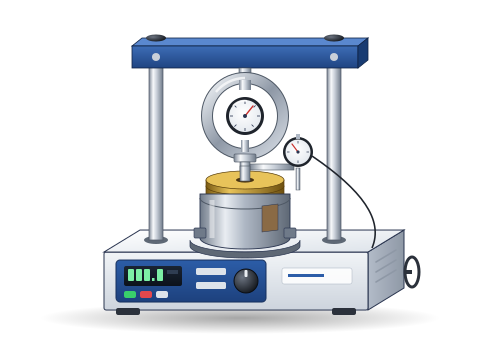
How CBR apparatus works
The resistance of a soil to penetration by a plunger under controlled conditions is compared with that of a standard crushed stone. CBR (%) = test load ÷ standard load × 100 at the same penetration, usually 2.5 mm; if the 5.0 mm value is higher, the test is repeated and the higher value used if confirmed.
The path of a sample
- 01
Prepare specimen
Soil is compacted in the CBR mould at the target dry density and moisture (static or dynamic compaction) over a spacer disc.
- 02
Soak (if required)
Surcharge weights are placed on the specimen and it is soaked for typically 96 hours, with a dial gauge on a tripod measuring swell.
- 03
Set up
The mould is placed on the frame with surcharge weights; the plunger is seated with a small load (about 4 kg) and gauges zeroed.
- 04
Penetrate
The plunger is driven at 1.25 mm/min; load is read at set penetrations (0.5, 1.0, 1.5, 2.0, 2.5, 3.0, 4.0, 5.0, 7.5, 10 and 12.5 mm).
- 05
Plot and correct
Load is plotted against penetration; if the curve is concave upward at the start, the zero is corrected.
- 06
Calculate CBR
Loads at 2.5 and 5.0 mm are divided by the standard loads and expressed as percentages.
Main parts and what they do
Load frame
Motorised screw jack or hydraulic frame that raises the mould against the plunger at a constant rate.
Proving ring or load cell
Measures the penetration load; rings of e.g. 10, 25 or 50 kN capacity are common.
Penetration plunger
Hardened steel cylinder about 50 mm in diameter (area about 19.6 cm²).
CBR mould with collar and base
Typically 150 mm internal diameter and 175 mm high, with a perforated base for soaking.
Spacer disc
Disc placed under the soil during compaction so the specimen height is about 127 mm.
Surcharge weights
Annular and slotted weights, typically 2.5 kg each.
Penetration dial gauge
Measures plunger penetration, typically 0.01 mm divisions.
Swell tripod and dial gauge
Measures specimen swell during soaking.
Soaking tank
Holds the moulds submerged during the soak period.
Terms every analyst should know
Standard load
Load carried by standard crushed stone: typically 1370 kg at 2.5 mm and 2055 kg at 5.0 mm (IS); ASTM uses about 6.9 MPa and 10.3 MPa on the plunger area.
Rate of penetration
1.25 mm/min (IS) or 1.27 mm/min (0.05 in/min, ASTM). Load readings depend on this rate.
Surcharge
Annular weights, typically 2.5 kg each, placed on the specimen to represent the weight of the pavement above.
Swell
Increase in specimen height during soaking, expressed as a percentage of the initial height.
Proving ring
Elastic steel ring whose deflection, read on a dial gauge, is proportional to load; its constant comes from a calibration certificate.
Keep every CBR apparatus in control: usage logs, calibration and maintenance schedules, and automatic blocking of overdue instruments.