Construction materials testing
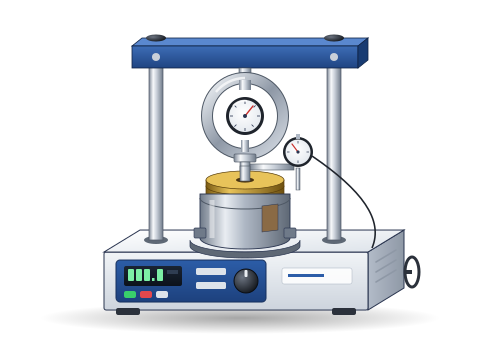
California Bearing Ratio (CBR) Test Apparatus
A load frame that pushes a 50 mm plunger into a compacted soil specimen at 1.25 mm/min and compares the load needed with that for a standard crushed stone. The ratio (CBR) is used to design road and pavement thickness.
- Road and highway construction
- Geotechnical testing
- Airports and railways
- Construction materials testing
- Academic labs
Follow your site SOP
This is a typical operating sequence for learning. Your instrument model and approved SOP take precedence.
STAGE 1
Before you start
- 1Check the load ring and penetration rate verification is in date and note the ring constant.
- 2Check the plunger is clean and undamaged.
- 3Prepare the specimen at the target density and moisture and soak it if required.
- Do not exceed the proving ring's capacity; choose a ring suited to the expected load.
STAGE 2
Setting up
- 1Drain the soaked specimen for about 15 minutes, keeping the surcharge on.
- 2Place the mould on the frame with the surcharge weights.
- 3Seat the plunger with a small seating load, then set the load and penetration gauges to zero.
STAGE 3
Penetration test
- 1Start the motor at 1.25 mm/min.
- 2Read the load at each standard penetration up to 12.5 mm.
- 3Stop the motor and lower the mould.
- 4Take a moisture sample from the top 30 mm of the specimen.
- Keep hands clear of the plunger and mould during loading.
STAGE 4
After testing
- 1Convert dial readings to load using the ring constant.
- 2Plot load against penetration, correct the origin if needed, and calculate CBR at 2.5 and 5.0 mm.
- 3Clean the mould, plunger and spacer disc.
In LimsPulse · Calibration Management
Keep every CBR apparatus in control: usage logs, calibration and maintenance schedules, and automatic blocking of overdue instruments.