CBR apparatus · Calibration procedure
Load ring and penetration rate verification
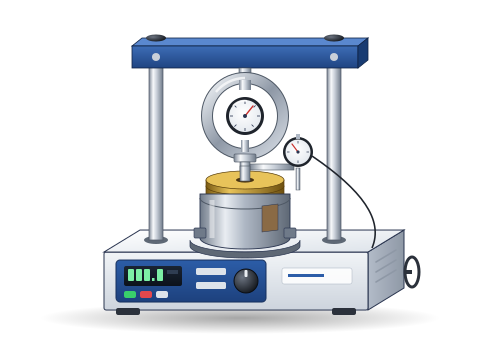
Confirms that the proving ring (or load cell) reads load correctly against a traceable reference, and that the load frame drives the plunger at 1.25 mm/min.
PURPOSE
Why this is checked
CBR is a ratio of measured load to standard load at fixed penetrations. A wrong ring constant gives a wrong CBR directly, and a wrong penetration rate changes the load the soil carries.
Frequency
Proving ring calibration typically every 12 months (or after overload or a knock); penetration rate typically every 6 to 12 months, as defined in your SOP.
Learn how the CBR apparatus worksYOU WILL NEED
Standards & tools
- Reference load cell or calibrated testing machine traceable to national standards (ASTM E74 / ISO 376 for the force reference)
- Calibrated stopwatch
- Calibrated dial gauge or displacement transducer (0.01 mm)
BEFORE YOU START
Prerequisites
- Proving ring exercised (pre-loaded) to its capacity three times
- Ring and reference at room temperature
PROCEDURE
Step by step
- 1Load ring: place the ring in series with the reference load cell in a loading frame; zero both.
- 2Apply loads at several points across the range (e.g. about 10% to 100% of capacity), recording ring dial divisions and reference load.
- 3Repeat for at least two more series; calculate the mean divisions at each load.
- 4Calculate the ring constant (load per division) or check the certified constant: ring load = divisions × constant; compare with reference.
- 5Penetration rate: mount a dial gauge between the platen and frame; run the motor and time the travel over e.g. 5.00 mm. Repeat three times.
- 6Calculate rate = travel ÷ time and compare with 1.25 mm/min.
RECORD
Example observation table
| Reference load (kN) | Ring reading (div) | Ring load = div × 0.0400 kN (kN) | Error (%) |
|---|---|---|---|
| 2 | 50.2 | 2.008 | +0.40 |
| 5 | 125.3 | 5.012 | +0.24 |
| 10 | 250.4 | 10.016 | +0.16 |
| 20 | 499.0 | 19.960 | −0.20 |
| 30 | 748.1 | 29.924 | −0.25 |
CALCULATION
How to calculate the result
Formula
Ring load = Divisions × Ring constant; Error % = (Ring load − Reference) ÷ Reference × 100; Rate = Travel ÷ Time
Worked example
- 1At 10 kN: 250.4 div × 0.0400 kN/div = 10.016 kN; error = (10.016 − 10) ÷ 10 × 100 = +0.16%
- 2Penetration rate: 5.00 mm in 242 s (4.033 min) → 5.00 ÷ 4.033 = 1.240 mm/min; 238 s → 1.261 mm/min; 240 s → 1.250 mm/min
- 3
All three are close to 1.25 mm/min.
- 4Effect on CBR: a load of 82 kg at 2.5 mm gives CBR = 82 ÷ 1370 × 100 = 6.0%; a 1% load error changes this by only about 0.06 percentage points, but a wrong ring constant used for every test biases all results.
ACCEPTANCE CRITERIA
Pass if
- Ring load within the SOP limit of the reference across the range (commonly ±1% of reading, or the class on its certificate).
- Penetration rate 1.25 mm/min (IS 2720 Part 16) or 1.27 mm/min (ASTM D1883), within the tolerance in your SOP (e.g. about ±0.1 mm/min).
- Ring returns to zero after unloading.
IF IT FAILS
What to do
- Withdraw the ring and have it recalibrated; use the new constant only after review.
- Service the drive if the rate is out of tolerance.
- Review CBR results reported since the last good verification.
In LimsPulse · Calibration Management
LimsPulse schedules this calibration, records the result against limits, and blocks the instrument everywhere if it fails or goes overdue.