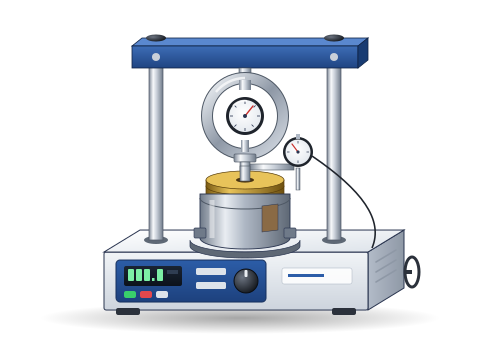
California Bearing Ratio (CBR) Test Apparatus
A load frame that pushes a 50 mm plunger into a compacted soil specimen at 1.25 mm/min and compares the load needed with that for a standard crushed stone. The ratio (CBR) is used to design road and pavement thickness.
- Road and highway construction
- Geotechnical testing
- Airports and railways
- Construction materials testing
- Academic labs
Test your CBR apparatus knowledge
Multiple-choice questions
Pick an answer to see whether you are right and why.
Q1. What is the rate of penetration in the CBR test under IS 2720 Part 16?
basicQ2. What is the standard load at 2.5 mm penetration under IS 2720 Part 16?
basicQ3. A soil carries 82 kg at 2.5 mm penetration. What is its CBR at 2.5 mm?
intermediateQ4. A proving ring reads 250.4 divisions; its constant is 0.0400 kN/div. What load does it indicate?
intermediateQ5. Why are surcharge weights placed on the specimen during soaking and testing?
intermediateQ6. The CBR at 5.0 mm is higher than at 2.5 mm. What does the standard usually require?
advanced
Viva questions
Think of your answer first, then open it to compare.
1. What is the California bearing ratio?
It is the load needed to push a standard plunger into a soil at a fixed rate to a given penetration, expressed as a percentage of the load that a standard crushed stone carries at the same penetration. It is used to design flexible pavement thickness.
2. How do you verify a CBR machine?
Calibrate the proving ring or load cell against a traceable reference at several loads and confirm or update its constant, and check the penetration rate by timing the platen travel over a known distance with a dial gauge to confirm 1.25 mm/min.
3. Why is a zero correction sometimes applied to the load–penetration curve?
If the plunger is not fully seated or the surface is uneven, the start of the curve is concave upward. The straight part of the curve is extended back to the penetration axis to find a corrected zero, and loads at 2.5 and 5.0 mm are read from that corrected origin.
Keep every CBR apparatus in control: usage logs, calibration and maintenance schedules, and automatic blocking of overdue instruments.