Construction materials testing
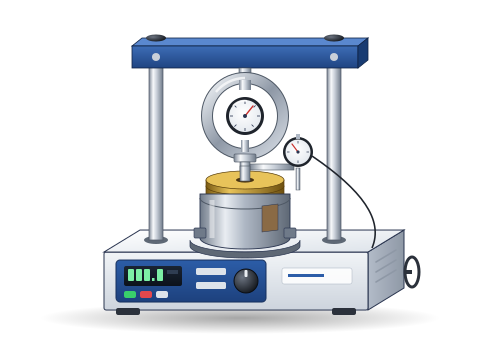
California Bearing Ratio (CBR) Test Apparatus
A load frame that pushes a 50 mm plunger into a compacted soil specimen at 1.25 mm/min and compares the load needed with that for a standard crushed stone. The ratio (CBR) is used to design road and pavement thickness.
- Road and highway construction
- Geotechnical testing
- Airports and railways
- Construction materials testing
- Academic labs
TROUBLESHOOTING
Common problems, causes and fixes
Load–penetration curve concave upward at the start
Likely causes
- • Uneven specimen surface
- • Plunger not properly seated
What to do
- • Apply the standard zero correction
- • Level the surface and seat the plunger before zeroing
CBR at 5.0 mm higher than at 2.5 mm
Likely causes
- • Typical of some granular soils
- • Surface softened by soaking
What to do
- • Repeat the test; if confirmed, report the 5.0 mm value as the standard requires
Penetration rate uneven
Likely causes
- • Worn gearbox or slipping drive
- • Motor speed variation
What to do
- • Service the drive
- • Verify rate with a stopwatch and dial gauge
Load dial does not return to zero
Likely causes
- • Ring overloaded and permanently deformed
- • Dial gauge sticking
What to do
- • Withdraw the ring and recalibrate or replace it
- • Service or replace the dial gauge
In LimsPulse · Calibration Management
Keep every CBR apparatus in control: usage logs, calibration and maintenance schedules, and automatic blocking of overdue instruments.