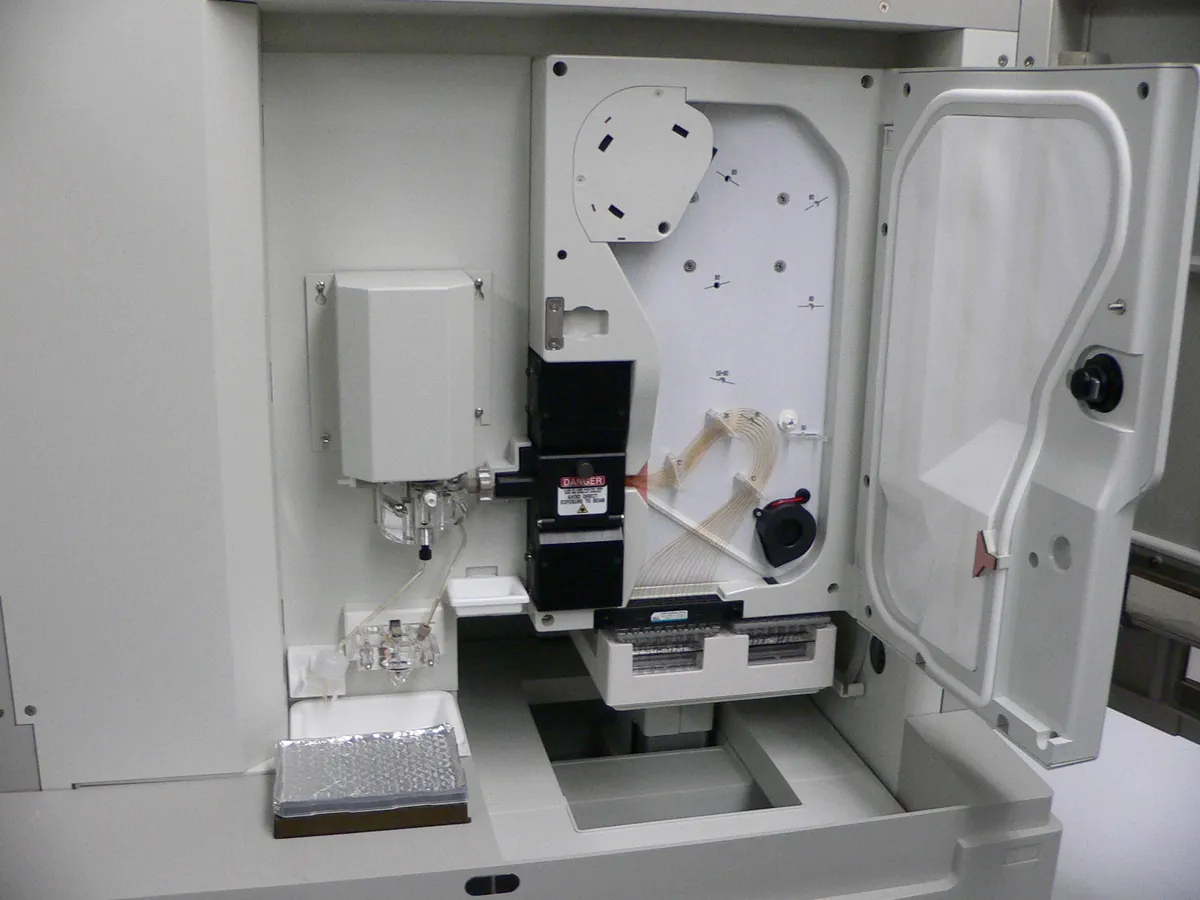
Capillary electrophoresis system
Separates charged molecules in a thin fused-silica capillary under a high voltage (typically up to 30 kV). Used in biologics QC for size purity (CE-SDS), charge variants (cIEF, CZE) and glycan analysis.
- Biotechnology
- Biopharmaceutical
- Pharmaceutical
- Genomics
- Forensic science
- Academic research
Test your CE knowledge
Multiple-choice questions
Pick an answer to see whether you are right and why.
Q1. What is electroosmotic flow (EOF)?
basicQ2. Which CE mode separates antibody charge variants by isoelectric point?
intermediateQ3. Why are peak areas divided by migration time in CE?
intermediateQ4. Current plotted against voltage curves upwards at high voltage. What does this show?
advancedQ5. Why can CE use much higher voltages than slab gels?
basicQ6. A voltage check at 20 kV reads 19.88 kV. What is the error?
intermediateQ7. What sudden change usually shows an air bubble or blockage in the capillary?
basic
Viva questions
Think of your answer first, then open it to compare.
1. Why are temperature and voltage verified on a CE system?
Mobility depends on buffer viscosity (about 2% change per °C) and on field strength, so errors in either shift migration times, resolution and sometimes peak areas. Verification confirms methods will perform as validated and transfer between instruments.
2. Name three CE modes used for monoclonal antibody QC and what each measures.
CE-SDS (reduced and non-reduced) for size purity and fragments; cIEF (or imaged cIEF) for charge variants by pI; CZE for charge variants by charge-to-size ratio. CE-LIF is also used for released glycan profiling.
3. Migration times drift later through a long sequence. What would you check?
Buffer depletion and ion changes in vials (replace more often), evaporation, capillary surface or coating changes (recondition or replace), cartridge temperature, and current stability. Bracketing standards and relative migration times help assess impact.
Keep every CE in control: usage logs, calibration and maintenance schedules, and automatic blocking of overdue instruments.