Blaine Air Permeability Apparatus
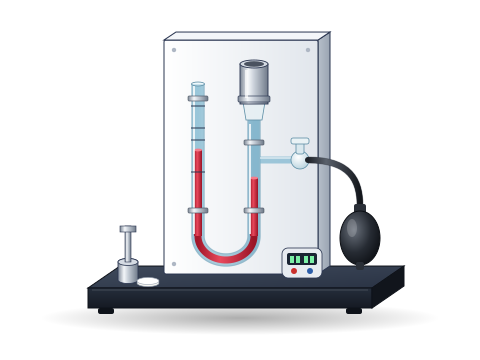
Measures the fineness of cement as specific surface area (m²/kg) by timing how long a fixed volume of air takes to pass through a compacted bed of cement.
- Cement manufacturing
- Construction materials testing
- Fly ash and slag suppliers
- Academic labs
What is Blaine?
Finer cement has more surface area per kilogram, so it reacts with water faster and gains strength earlier. The Blaine apparatus measures fineness indirectly. A small bed of cement is compacted to a known porosity in a cell, and air is drawn through the bed by a U-tube manometer. The finer the cement, the more resistance the bed offers and the longer the air takes to pass.
The time for the manometer liquid to fall between two etched marks is related to specific surface by the Kozeny–Carman equation. Because the apparatus is a comparison instrument, it is calibrated with a reference cement of known specific surface to find the apparatus constant and the bed volume.
IS 4031 Part 2 and ASTM C204 describe the method. For ordinary Portland cement, IS 269 typically specifies a minimum specific surface of 225 m²/kg; most modern cements are well above that.
Used for
- Fineness (specific surface) of OPC, PPC and other cements
- Production control of cement mill grinding
- Fineness of fly ash, slag and other mineral admixtures
- Fineness of lime, gypsum and fine powders in research
How it works
- 01
Weigh sample
Mass = density × bed volume × (1 − porosity), so the bed has the target porosity (typically 0.500 for OPC).
- 02
Form the bed
The cement is placed on a perforated disc with filter paper above and below, and compacted with the plunger until its collar meets the cell top.
- 03
Fit cell
The cell is fitted to the manometer with a ground-glass or rubber seal so no air leaks.
- 04
Draw air
Suction raises the manometer liquid to the top mark, then the tap is closed.
- 05
Time the fall
Air passes through the bed as the liquid falls; the time between the second and third marks is measured.
- 06
Calculate
Specific surface is calculated from the time using the apparatus constant, density and porosity.
Advantages
- Fast: a test takes about 15 minutes
- Inexpensive and robust
- Long-established method with specification limits built on it
- Semi-automatic versions remove the stopwatch reading error
Limitations
- Indirect: gives a comparative value, not a true particle size distribution
- Needs careful calibration with a reference material and mercury displacement (or an equivalent) for bed volume
- Results depend on bed porosity, temperature and correct cement density
- Less reliable for very fine or porous materials such as silica fume
1 calibration procedure
Methods that use Blaine
Keep every Blaine in control: usage logs, calibration and maintenance schedules, and automatic blocking of overdue instruments.