Blaine Air Permeability Apparatus
Measures the fineness of cement as specific surface area (m²/kg) by timing how long a fixed volume of air takes to pass through a compacted bed of cement.
- Cement manufacturing
- Construction materials testing
- Fly ash and slag suppliers
- Academic labs
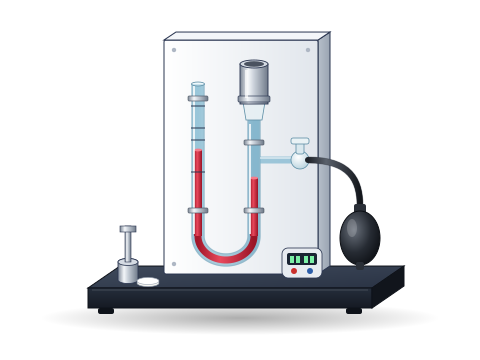
How Blaine works
Air flow through a packed powder bed depends on the bed's porosity and the specific surface of the particles (Kozeny–Carman). If porosity, bed volume and air viscosity are kept constant, specific surface is proportional to the square root of the flow time, so S = K × √t (with density and porosity terms). K is found by calibrating with a reference cement of known specific surface.
The path of a sample
- 01
Weigh sample
Mass = density × bed volume × (1 − porosity), so the bed has the target porosity (typically 0.500 for OPC).
- 02
Form the bed
The cement is placed on a perforated disc with filter paper above and below, and compacted with the plunger until its collar meets the cell top.
- 03
Fit cell
The cell is fitted to the manometer with a ground-glass or rubber seal so no air leaks.
- 04
Draw air
Suction raises the manometer liquid to the top mark, then the tap is closed.
- 05
Time the fall
Air passes through the bed as the liquid falls; the time between the second and third marks is measured.
- 06
Calculate
Specific surface is calculated from the time using the apparatus constant, density and porosity.
Main parts and what they do
Permeability cell
Rigid metal cylinder that holds the cement bed.
Perforated disc
Supports the bed at a fixed height in the cell.
Plunger
Compacts the bed to a fixed thickness; its collar stops at the cell top.
Filter paper discs
Circular papers placed below and above the bed to keep it in place.
U-tube manometer
Glass tube with etched marks, filled to the lowest mark with a non-volatile, low-density liquid (e.g. light mineral oil).
Rubber bulb and tap
Create suction to raise the liquid, then isolate the system.
Stopwatch or timer
Measures the flow time to 0.2 s or better; automatic units use optical sensors.
Terms every analyst should know
Specific surface
Total surface area of particles per unit mass, reported in m²/kg (or cm²/g; 1 m²/kg = 10 cm²/g).
Bed porosity (e)
Fraction of the bed volume that is air. Fixed at a set value (e.g. 0.500) so results are comparable.
Apparatus constant (K)
A constant specific to each cell–manometer pair, found with a reference cement. It changes if the cell, plunger or manometer is replaced.
Bed volume (V)
Volume of the compacted bed, usually determined by mercury displacement or by a calibration method given in the standard.
Temperature effect
Air viscosity changes with temperature. Tests are usually done within a few degrees of the calibration temperature, or a viscosity correction is applied.
Keep every Blaine in control: usage logs, calibration and maintenance schedules, and automatic blocking of overdue instruments.