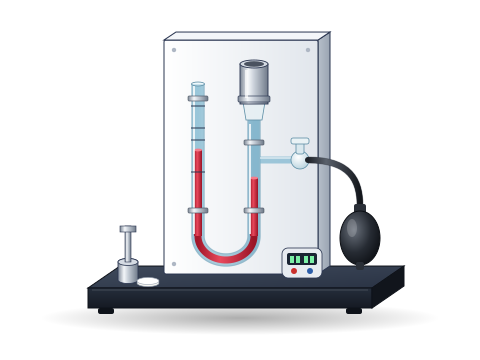
Blaine Air Permeability Apparatus
Measures the fineness of cement as specific surface area (m²/kg) by timing how long a fixed volume of air takes to pass through a compacted bed of cement.
- Cement manufacturing
- Construction materials testing
- Fly ash and slag suppliers
- Academic labs
Test your Blaine knowledge
Multiple-choice questions
Pick an answer to see whether you are right and why.
Q1. In what unit is Blaine fineness usually reported under IS 4031 Part 2?
basicQ2. Compared with a coarse cement, a finer cement in the Blaine apparatus gives:
basicQ3. Reference cement (3250 cm²/g) gives 52.0 s. A test cement of the same density and porosity gives 45.2 s. Its specific surface is about:
intermediateQ4. Why is the sample mass calculated from density, bed volume and porosity?
intermediateQ5. What is the typical minimum Blaine fineness for OPC under IS 269?
intermediateQ6. After replacing the manometer liquid, what must you do before reporting results?
advanced
Viva questions
Think of your answer first, then open it to compare.
1. What is the principle of the Blaine air permeability method?
Air is drawn through a compacted bed of cement of known porosity. The time for a fixed volume of air to pass depends on the bed's resistance, which depends on the specific surface of the particles (Kozeny–Carman). Comparing with a reference cement gives the specific surface.
2. How is the bed volume of the Blaine cell determined?
Usually by mercury displacement: weigh the cell filled with mercury above two filter papers, then form a cement bed and fill the remaining space with mercury and weigh again. The mass difference divided by mercury density gives the bed volume. Some standards allow alternative methods that avoid mercury.
3. Why does Blaine fineness not fully describe a cement's grading?
It gives a single value of surface area, which can be the same for cements with different particle size distributions. It is also sensitive to very fine particles. Laser diffraction or sieve residue gives more information on the distribution.
Keep every Blaine in control: usage logs, calibration and maintenance schedules, and automatic blocking of overdue instruments.