Fineness of cement by Blaine air permeability
Measures the fineness of cement as specific surface — the total surface area of the particles in one kilogram (m²/kg). Finer cement hydrates faster and gains early strength faster, but needs more water and releases heat faster.
- Construction materials
- Blaine air permeability apparatus
- Blaine
- Analytical balance
Reference: Based on IS 4031 (Part 2) and ASTM C204. Follow the current editions and your laboratory SOP.
Why this method works
Air is drawn through a compacted bed of cement of known porosity. The time for a fixed volume of air to pass depends on how fine the particles are: a finer powder has smaller pores, so air flows more slowly. Following the Kozeny–Carman relationship, specific surface is proportional to the square root of the flow time. The apparatus is calibrated with a reference cement of known specific surface to obtain an apparatus constant, so the test cement can be calculated by comparison.
Instruments used
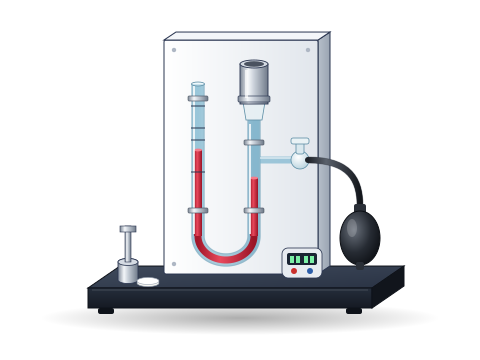
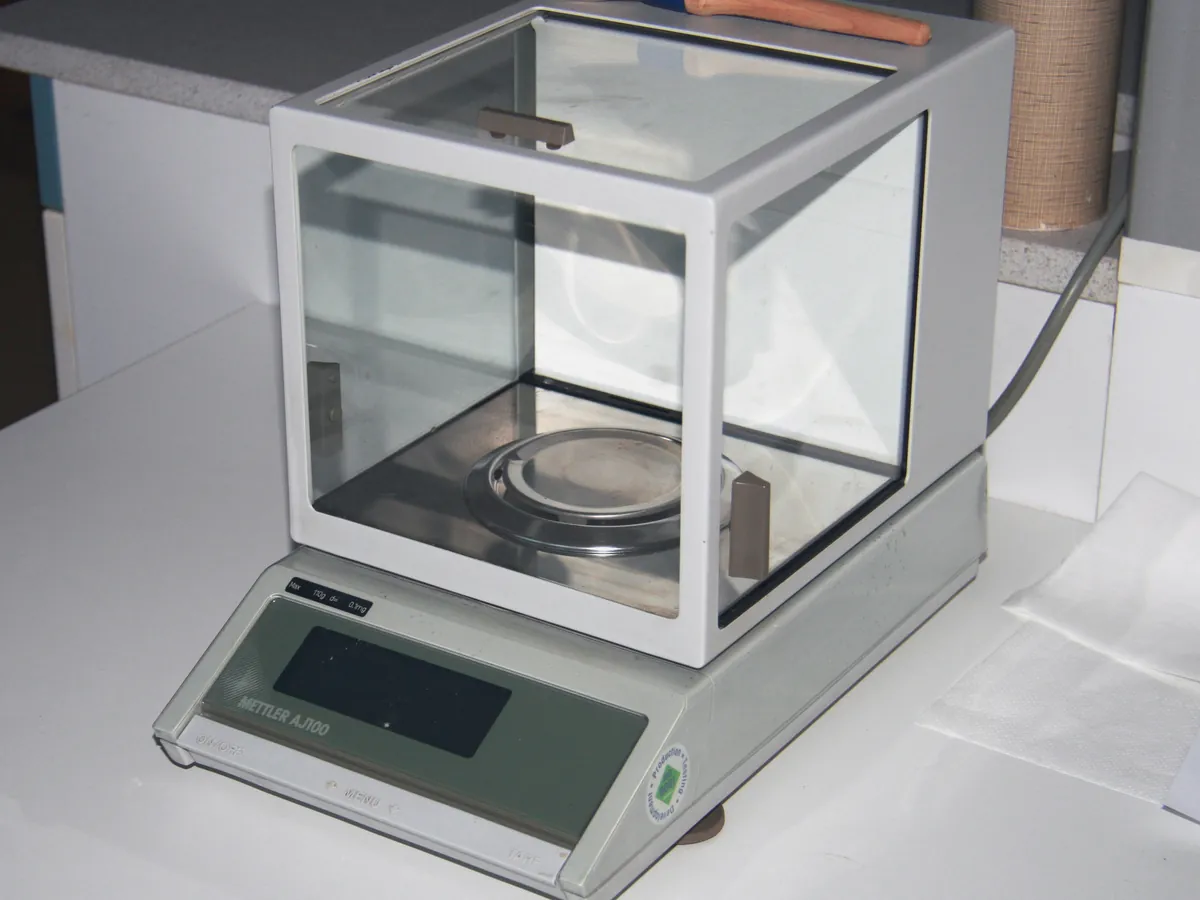
Reagents & standards
| Reagent | Grade / specification |
|---|---|
| Reference cement | Of certified specific surface (e.g. a national reference material), for the apparatus constant |
| Manometer liquid | Non-volatile, non-hygroscopic liquid of low viscosity and density (e.g. dibutyl phthalate or light mineral oil) |
| Filter paper discs | Medium-retention, cut to the cell diameter |
| Mercury (if bed volume is found by mercury displacement) | Reagent grade; follow site rules for mercury handling |
Preparing the sample
- 01
Density
Know the density of the cement (often about 3.15 g/cm³ for OPC).
- 02
Bed mass
Calculate the mass for a bed of porosity 0.500.
- 03
Prepare bed
Paper disc, cement, paper disc; compact with the plunger.
- 04
Draw air
Raise the manometer liquid to the top mark.
- 05
Time flow
Time the meniscus between the two timing marks.
- 06
Repeat
Re-form the bed and repeat; average the times.
Procedure
- 1Bring the sample and apparatus to room temperature (typically 27 ± 2 °C) and keep RH low enough that the cement does not absorb moisture.
- 2Find the bed volume V of the cell (by mercury displacement or as given on the current calibration record).
- 3Calculate the mass of cement for the chosen porosity: W = ρ × V × (1 − ε). For ρ = 3.15 g/cm³, V = 1.85 cm³ and ε = 0.500, W = 2.914 g.
- 4Place the perforated disc and one filter paper in the cell. Add the weighed cement, tap to level, add a second filter paper and compress with the plunger until its collar meets the top of the cell. Withdraw the plunger slowly.
- 5Attach the cell to the manometer with an airtight seal. Draw the liquid up to the top mark using the bulb, then close the valve.
- 6Start the timer when the bottom of the meniscus passes the second mark and stop it when it passes the third mark (follow the mark numbering on your apparatus). Record the time T in seconds and the temperature.
- 7Repeat the measurement on a freshly prepared bed and average the times if they agree as required by your SOP.
- 8Calculate the specific surface using the apparatus constant determined with the reference cement at the same porosity.
Standard preparation
- 1Determine the apparatus constant with the reference cement in exactly the same way, at the same porosity, at least as often as your calibration schedule requires and whenever the manometer liquid or cell is changed.
Notes for analysts
- The full formula in IS 4031 (Part 2) and ASTM C204 also includes the bed porosity and air viscosity terms. When the test and reference cements are run at the same porosity and temperature, those terms cancel and the simple comparison above is used.
- Bed preparation is the main source of error. Compact the bed the same way every time and never reuse a bed.
- Older IS 4031 practice also allowed fineness by dry sieving on a 90 µm sieve; the specific surface method is the one used in current OPC specifications.
Method parameters (typical)
| Bed porosity (ε) | Typically 0.500 for OPC (adjusted for some cements as per the standard) |
|---|---|
| Density of OPC (ρ) | About 3.15 g/cm³ (measure for blended cements) |
| Bed volume (V) | About 1.8–1.9 cm³ (from calibration) |
| Flow time | Usually between about 30 and 100 seconds for OPC |
| Units | m²/kg (older reports use cm²/g; 1 m²/kg = 10 cm²/g) |
System suitability & sequence
| Parameter | Limit |
|---|---|
| Apparatus constant | Current; determined with reference cement |
| Leak test | Manometer liquid holds steady with the cell outlet sealed |
| Duplicate flow times | Agree within the tolerance set in your SOP (often a few tenths of a second to about 1 s) |
Typical sequence
- 1Leak check of manometer and cell
- 2Reference cement (if constant is due) × 2 beds
- 3Test cement × 2 beds
Calculation with a worked example
Where
- S
- Specific surface of the test cement (m²/kg)
- K
- Apparatus constant from the reference cement
- T
- Mean flow time for the test cement (s)
- ρ
- Density of the test cement (g/cm³)
- Ss
- Certified specific surface of the reference cement (m²/kg)
- ρs
- Density of the reference cement (g/cm³)
- Ts
- Mean flow time for the reference cement (s)
Given
- Ss
- 280 m²/kg
- ρs
- 3.15 g/cm³
- Ts
- 52.0 s
- ρ (test cement)
- 3.15 g/cm³
- T (mean of two beds)
- 46.5 s
- Porosity, both cements
- 0.500
Working
- 1√Ts = √52.0 = 7.211
- 2
K = 280 × 3.15 / 7.211 = 882 / 7.211 = 122.31
- 3√T = √46.5 = 6.819
- 4
S = 122.31 × 6.819 / 3.15 = 834.0 / 3.15 = 264.8 m²/kg
Specific surface = 265 m²/kg (rounded), which is above the typical OPC minimum of 225 m²/kg.
What result passes
- For OPC to IS 269, specific surface is typically required to be not less than 225 m²/kg. Blended and special cements have their own limits in their product standards.
- Most commercial OPC falls roughly in the 280–380 m²/kg range; results far above or below should be checked.
Validation parameters (ICH Q2(R2))
| Parameter | Typical requirement |
|---|---|
| Apparatus constant | Re-determine at the frequency set in your calibration schedule and after any change of liquid or cell |
| Repeatability | Duplicate results typically agree within about 1–2% of the mean |
| Limitations | Assumes the cement density is known; blended cements with very different densities or particle shapes need care |
Run this method in LimsPulse: specifications and STPs under version control, results calculated and checked against limits, and a signed Certificate of Analysis.