Aggregate Impact Value Tester
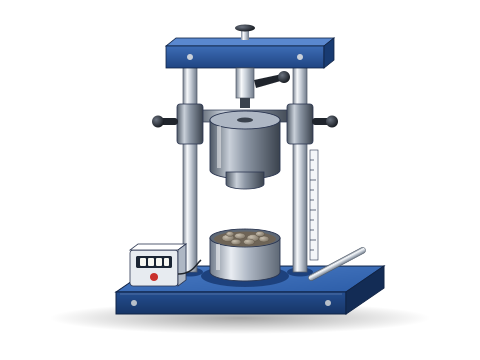
A drop-hammer machine that strikes a cup of coarse aggregate 15 times and measures how much it breaks into fines. The result, the aggregate impact value (AIV), shows the aggregate's toughness.
- Construction materials testing
- Road and highway construction
- Quarries and crushers
- Ready-mix concrete
- Academic labs
What is AIV tester?
Aggregates in roads and concrete floors are hit repeatedly by traffic. The aggregate impact value test measures resistance to sudden shock. A sample of aggregate (typically passing 12.5 mm and retained on 10 mm) is compacted in a steel cup, and a hammer of about 13.5 to 14.0 kg is dropped on it 15 times from a height of about 380 mm.
The crushed sample is sieved on a 2.36 mm sieve. The mass passing, as a percentage of the original mass, is the aggregate impact value. A lower AIV means a tougher aggregate.
The method is in IS 2386 Part 4. IS 383 typically limits AIV to not more than 45% for aggregate used in general concrete and not more than 30% for concrete wearing surfaces such as runways, roads and pavements.
Used for
- Toughness of coarse aggregate for concrete (IS 383 limits)
- Suitability of road aggregates for bituminous and base courses
- Comparing quarry sources during material approval
- Routine quality control of crushed stone
How it works
- 01
Prepare sample
Aggregate passing 12.5 mm and retained on 10 mm is oven-dried (or surface-dried, as the method states) and cooled.
- 02
Measure volume
The measure (about 75 mm diameter × 50 mm deep) is filled in three layers, each tamped 25 times, and the mass recorded (A).
- 03
Compact in cup
The weighed sample is transferred to the cup (about 102 mm diameter × 50 mm deep) fixed to the base and tamped 25 times.
- 04
Impact
The hammer is raised to its stop and released 15 times, each blow at an interval of at least about one second.
- 05
Sieve
The crushed aggregate is sieved on a 2.36 mm sieve and the mass passing recorded (B).
- 06
Calculate
AIV = B ÷ A × 100, reported as the mean of two tests to the nearest whole number.
Advantages
- Simple, quick and inexpensive
- Small sample size (about 300 g per test)
- Good indicator of toughness for road aggregates
- No power needed for manual machines; counters available on automatic ones
Limitations
- Tests only one size fraction; results may not represent the whole grading
- Weak aggregates may give misleading results; a modified procedure is used for soaked or weak aggregates
- Hammer must fall freely; friction in the guides reduces the energy
- Small sample makes careful sampling and sieving essential
1 calibration procedure
Methods that use AIV tester
Keep every AIV tester in control: usage logs, calibration and maintenance schedules, and automatic blocking of overdue instruments.