Aggregate Impact Value Tester
A drop-hammer machine that strikes a cup of coarse aggregate 15 times and measures how much it breaks into fines. The result, the aggregate impact value (AIV), shows the aggregate's toughness.
- Construction materials testing
- Road and highway construction
- Quarries and crushers
- Ready-mix concrete
- Academic labs
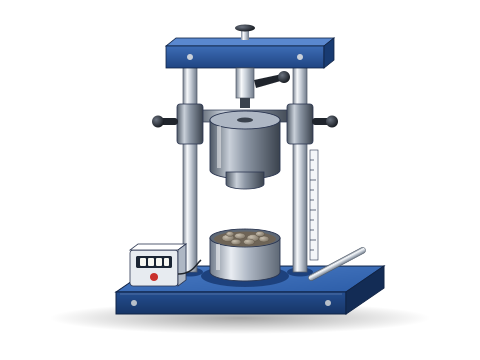
How AIV tester works
Each hammer blow delivers a fixed energy (mass × gravity × drop height, roughly 51 J per blow for a 13.75 kg hammer falling 380 mm). Weak or brittle aggregate breaks into more fine particles. The fraction passing 2.36 mm after 15 blows expresses resistance to impact.
The path of a sample
- 01
Prepare sample
Aggregate passing 12.5 mm and retained on 10 mm is oven-dried (or surface-dried, as the method states) and cooled.
- 02
Measure volume
The measure (about 75 mm diameter × 50 mm deep) is filled in three layers, each tamped 25 times, and the mass recorded (A).
- 03
Compact in cup
The weighed sample is transferred to the cup (about 102 mm diameter × 50 mm deep) fixed to the base and tamped 25 times.
- 04
Impact
The hammer is raised to its stop and released 15 times, each blow at an interval of at least about one second.
- 05
Sieve
The crushed aggregate is sieved on a 2.36 mm sieve and the mass passing recorded (B).
- 06
Calculate
AIV = B ÷ A × 100, reported as the mean of two tests to the nearest whole number.
Main parts and what they do
Base
Heavy metal base, typically 45–60 kg, bedded on a level concrete floor.
Cylindrical steel cup
Holds the sample; internal diameter about 102 mm, depth about 50 mm; clamped to the base.
Hammer
Steel hammer of about 13.5–14.0 kg with a flat face about 100 mm in diameter.
Guide columns
Two vertical columns along which the hammer slides freely.
Lifting and release mechanism
Raises the hammer to a fixed height (about 380 ± 5 mm above the sample) and releases it.
Blow counter
Counts blows; automatic machines stop at 15.
Measure and tamping rod
Cylindrical measure (about 75 mm × 50 mm) and a 10 mm rod about 230 mm long for compacting.
Sieves
12.5 mm, 10 mm and 2.36 mm IS sieves for preparing and testing the sample.
Terms every analyst should know
Aggregate impact value (AIV)
Percentage of fines (passing 2.36 mm) produced by the standard impact; lower is tougher.
Toughness
Resistance to sudden impact, as distinct from crushing strength under slowly applied load.
Free fall
The hammer must drop freely in its guides so each blow delivers the full energy.
Machine base
A heavy base (typically 45 to 60 kg) on a firm floor absorbs the blow so energy goes into the sample.
Keep every AIV tester in control: usage logs, calibration and maintenance schedules, and automatic blocking of overdue instruments.