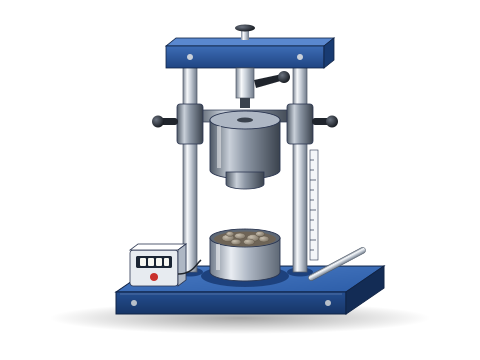
Aggregate Impact Value Tester
A drop-hammer machine that strikes a cup of coarse aggregate 15 times and measures how much it breaks into fines. The result, the aggregate impact value (AIV), shows the aggregate's toughness.
- Construction materials testing
- Road and highway construction
- Quarries and crushers
- Ready-mix concrete
- Academic labs
Test your AIV tester knowledge
Multiple-choice questions
Pick an answer to see whether you are right and why.
Q1. How many hammer blows are given in the aggregate impact value test?
basicQ2. What sieve is used to separate the fines after the impact test?
basicQ3. A sample of 320.0 g gives 52.5 g passing the test sieve. What is the AIV?
intermediateQ4. What is the typical IS 383 limit on AIV for aggregate used in concrete wearing surfaces?
intermediateQ5. The typical hammer mass and drop height in IS 2386 Part 4 are:
intermediateQ6. AIV results on a known aggregate are lower than usual. Which cause is most likely?
advanced
Viva questions
Think of your answer first, then open it to compare.
1. What does the aggregate impact value tell you?
It measures the toughness of coarse aggregate: its resistance to sudden impact. A lower AIV means a tougher aggregate, better suited to roads and wearing surfaces.
2. How do you check the impact tester is delivering the correct energy?
Weigh the hammer (typically 13.5–14.0 kg), measure the drop height from the hammer face to the sample surface (380 ± 5 mm), check that it falls freely, and calculate energy = m × g × h (about 51 J per blow).
3. Why must the machine be bedded on a firm floor?
If the base rocks or the floor is soft, part of the hammer's energy goes into moving the machine instead of crushing the aggregate, giving low AIV results.
Keep every AIV tester in control: usage logs, calibration and maintenance schedules, and automatic blocking of overdue instruments.