Atomic Absorption Spectrophotometer (AAS)
Measures one metal at a time by how much light of that element's own wavelength is absorbed by free atoms in a flame or graphite furnace. Simple, robust and still widely used for metals in pharma QC.
- Pharmaceutical
- Food & beverage
- Environmental
- Mining & metallurgy
- Agriculture
- Clinical
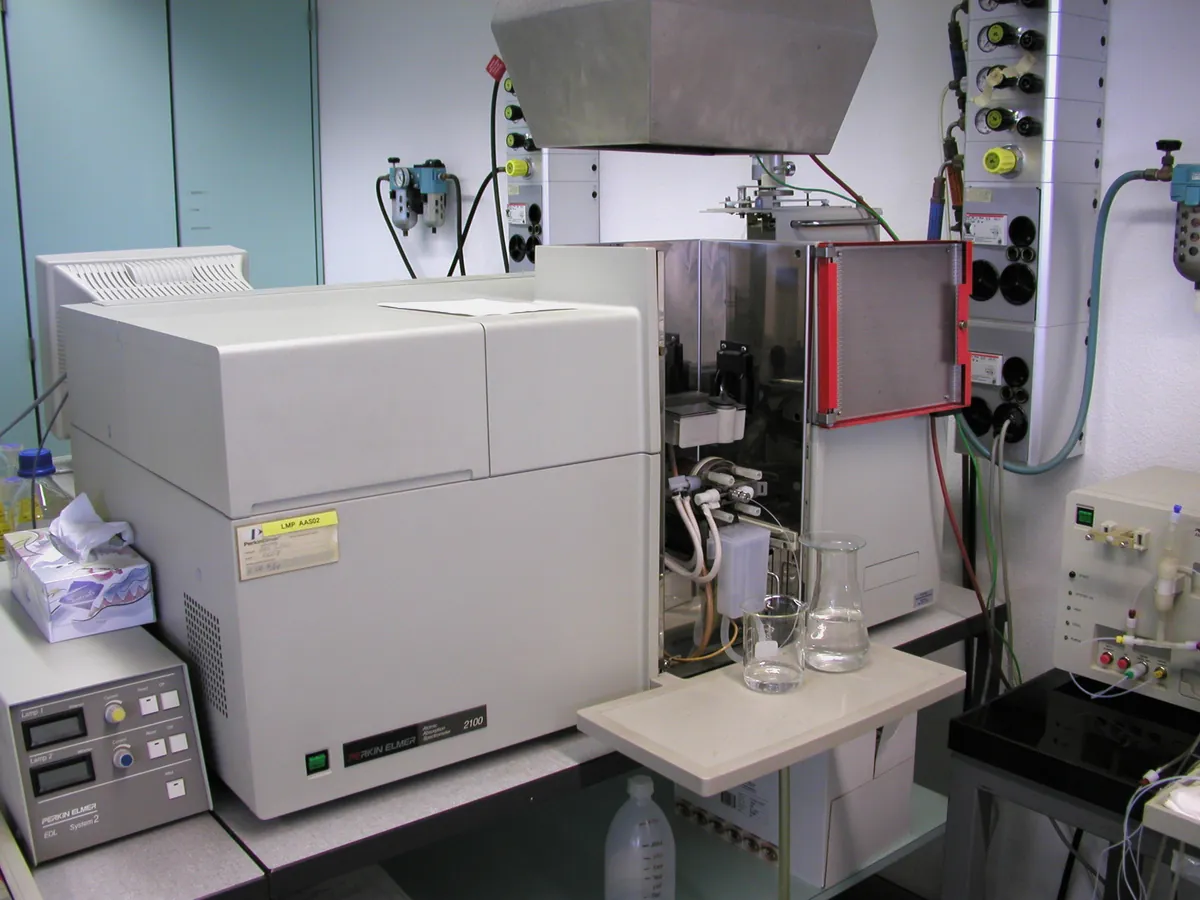
How AAS works
Free ground-state atoms absorb light at wavelengths characteristic of the element. Within the linear range the absorbance is proportional to the concentration of the element in the solution, as in the Beer–Lambert law, so concentration is read from a calibration curve of standards.
The path of a sample
- 01
Light source
A hollow cathode lamp (or electrodeless discharge lamp) of the analyte element emits its sharp resonance lines.
- 02
Sample introduction
The nebuliser sucks up the sample solution and turns it into a fine mist (flame), or an autosampler injects a few µL into the graphite tube (furnace).
- 03
Atomisation
The flame or the heated graphite tube dries the sample, breaks down the matrix and releases free atoms.
- 04
Absorption
The atom cloud absorbs part of the lamp light at the resonance wavelength.
- 05
Monochromator
Selects the chosen line (e.g. Cu 324.8 nm) and rejects other light.
- 06
Detector and readout
A photomultiplier or solid-state detector measures the transmitted light; the software converts it to absorbance and concentration.
Main parts and what they do
Hollow cathode lamp (HCL) / EDL
Element-specific light source; the turret may hold several lamps that are warmed up before use.
Burner and nebuliser (flame)
Aspirates the sample, forms an aerosol in the spray chamber and burns it in a slot burner, usually air–acetylene or nitrous oxide–acetylene.
Graphite furnace (optional)
A small graphite tube heated in steps (dry, ash, atomise, clean) under argon, fed by an autosampler.
Gas control
Regulates fuel and oxidant flows; includes safety interlocks for flame ignition and flashback.
Monochromator
Grating and slits that isolate the analytical line from the lamp and flame emission.
Background corrector
Deuterium lamp or Zeeman magnet that measures and removes non-specific absorption.
Detector
Photomultiplier tube or solid-state detector that measures light intensity.
Software
Controls the instrument, builds calibration curves, calculates results and keeps the audit trail.
Terms every analyst should know
Characteristic concentration
The concentration that gives 1% absorption (absorbance 0.0044). A smaller value means a more sensitive instrument set-up.
Background correction
Broad-band absorption and scatter from the matrix are removed with a deuterium lamp or Zeeman correction, otherwise results read high.
Chemical interference
Stable compounds in the flame (e.g. calcium phosphate) reduce the free atoms. A releasing agent such as lanthanum or a hotter nitrous oxide–acetylene flame overcomes it.
Ionisation interference
Easily ionised elements (Na, K) partly ionise in hot flames and stop absorbing. Adding excess caesium or potassium as an ionisation buffer suppresses this.
Flame vs furnace
Flame is fast and robust at mg/L; graphite furnace is slower but about 100–1000 times more sensitive.
Hydride and cold vapour
As, Se, Sb and Bi are converted to volatile hydrides, and Hg to atomic vapour, which greatly improves their detection limits.
Keep every AAS in control: usage logs, calibration and maintenance schedules, and automatic blocking of overdue instruments.