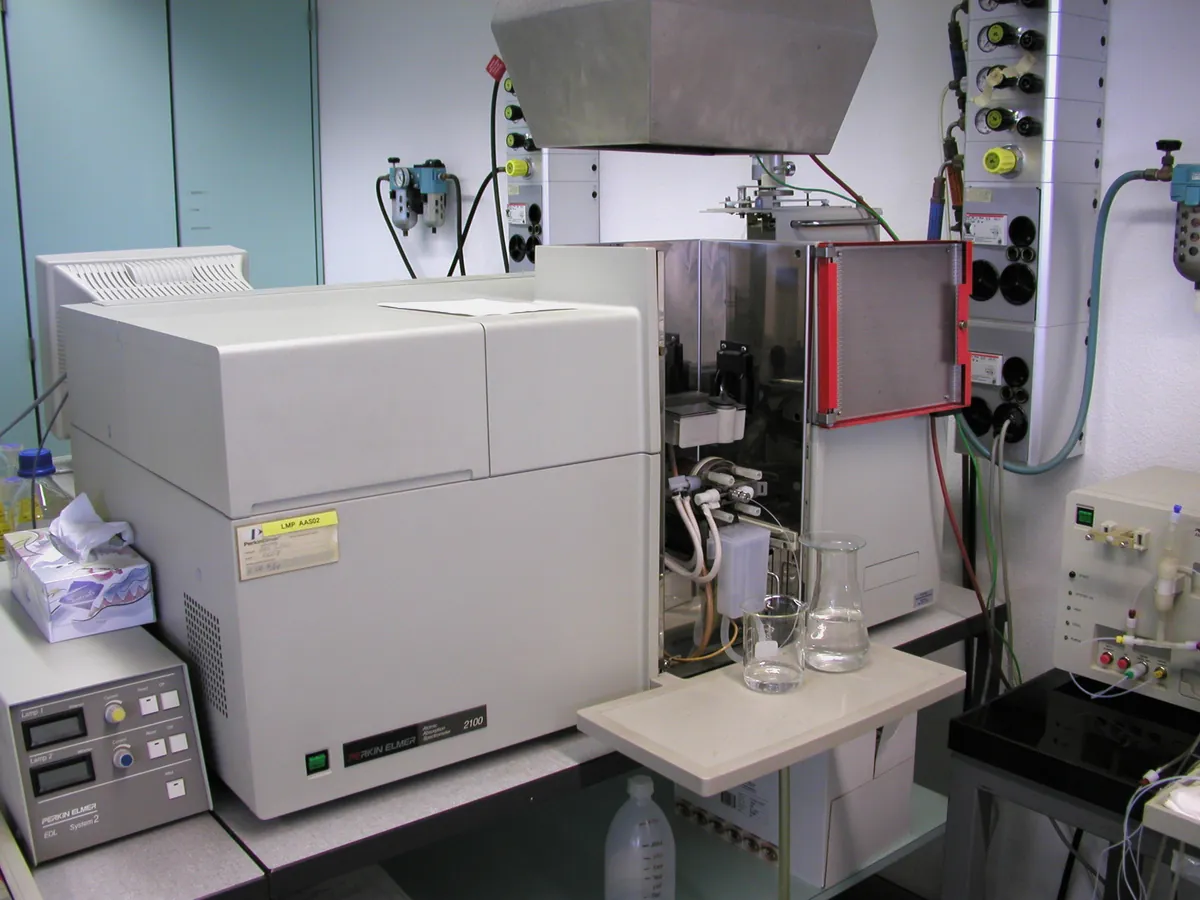
Atomic Absorption Spectrophotometer (AAS)
Measures one metal at a time by how much light of that element's own wavelength is absorbed by free atoms in a flame or graphite furnace. Simple, robust and still widely used for metals in pharma QC.
- Pharmaceutical
- Food & beverage
- Environmental
- Mining & metallurgy
- Agriculture
- Clinical
Test your AAS knowledge
Multiple-choice questions
Pick an answer to see whether you are right and why.
Q1. What is the usual light source in an atomic absorption spectrophotometer?
basicQ2. In AAS, which species absorb the lamp light?
basicQ3. Characteristic concentration in AAS is the concentration that gives an absorbance of:
basicQ4. Calcium results are low in a sample high in phosphate. What is the usual remedy?
intermediateQ5. Why is caesium or potassium chloride added when measuring sodium or potassium by flame AAS?
intermediateQ6. Which technique is used to correct for non-specific background absorption in AAS?
intermediateQ7. A 2.0 mg/L copper standard gives an absorbance of 0.200. What is the characteristic concentration?
advanced
Viva questions
Think of your answer first, then open it to compare.
1. Why does AAS normally measure only one element at a time?
Each hollow cathode lamp emits the lines of one element (or a few in multi-element lamps), and the instrument measures absorption at one line at a time. Changing element means changing lamp and settings.
2. Compare flame and graphite furnace AAS.
Flame AAS is fast, robust and precise at mg/L levels but uses a lot of sample and atomises inefficiently. Graphite furnace AAS puts a few µL into a heated tube, keeps atoms in the light path longer and reaches µg/L levels, but is slower and needs careful temperature programmes and matrix modifiers.
3. What safety checks do you make before lighting an air–acetylene flame?
Exhaust running, burner head correctly seated, drain trap filled, gas pressures correct with no leaks, acetylene cylinder above its minimum pressure, and the correct ignition sequence (oxidant before fuel). Never leave the flame unattended.
Keep every AAS in control: usage logs, calibration and maintenance schedules, and automatic blocking of overdue instruments.