Atomic Absorption Spectrophotometer (AAS)
Measures one metal at a time by how much light of that element's own wavelength is absorbed by free atoms in a flame or graphite furnace. Simple, robust and still widely used for metals in pharma QC.
- Pharmaceutical
- Food & beverage
- Environmental
- Mining & metallurgy
- Agriculture
- Clinical
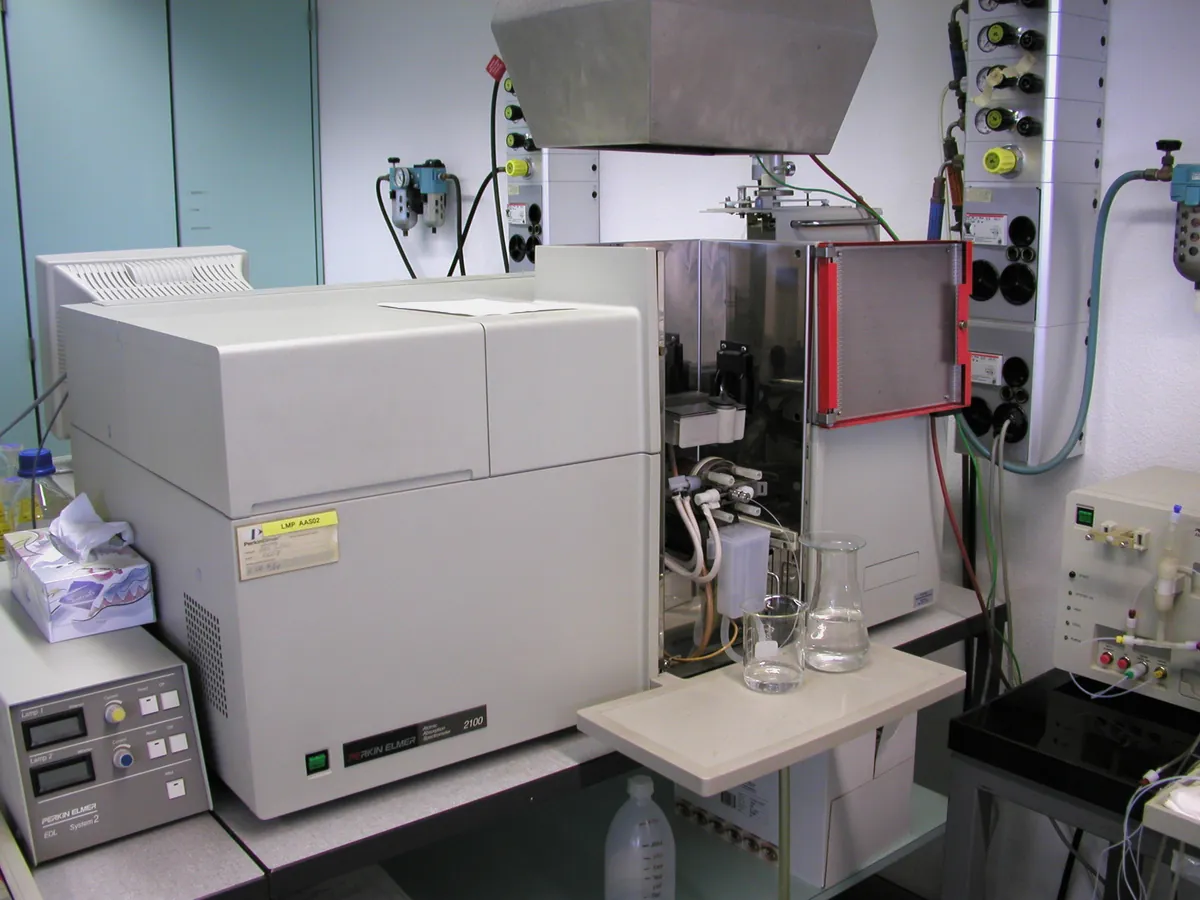
What is AAS?
An atomic absorption spectrophotometer turns the sample into a cloud of free, ground-state atoms, usually in an air–acetylene flame or a small electrically heated graphite tube. A lamp made of the element being measured shines light through the atom cloud. The atoms absorb light at exactly the wavelengths they would emit, so the drop in light intensity tells you how many atoms of that element are present.
Because the lamp emits only the lines of one element, AAS is highly selective. The price is that it measures one element per lamp, so a multi-element survey is slow. Flame AAS works in the mg/L (ppm) range; graphite furnace AAS reaches µg/L (ppb) levels with much smaller sample volumes.
In pharmaceutical QC, AAS is used for specific metal tests in monographs (for example sodium, potassium, zinc, magnesium or calcium content), catalyst residues such as palladium, and for elemental impurities where a validated AAS procedure is fit for purpose. Many labs now use ICP-OES or ICP-MS for multi-element ICH Q3D work, but AAS remains common for single-element assays.
Used for
- Assay of metal-containing APIs and salts (e.g. zinc, magnesium, calcium, iron)
- Sodium and potassium content in APIs and infusions
- Residual metal catalysts (e.g. palladium, nickel) in APIs
- Single-element elemental impurity tests where validated
- Heavy metals in herbal materials and excipients
- Mercury by cold-vapour AAS and arsenic or selenium by hydride generation
How it works
- 01
Light source
A hollow cathode lamp (or electrodeless discharge lamp) of the analyte element emits its sharp resonance lines.
- 02
Sample introduction
The nebuliser sucks up the sample solution and turns it into a fine mist (flame), or an autosampler injects a few µL into the graphite tube (furnace).
- 03
Atomisation
The flame or the heated graphite tube dries the sample, breaks down the matrix and releases free atoms.
- 04
Absorption
The atom cloud absorbs part of the lamp light at the resonance wavelength.
- 05
Monochromator
Selects the chosen line (e.g. Cu 324.8 nm) and rejects other light.
- 06
Detector and readout
A photomultiplier or solid-state detector measures the transmitted light; the software converts it to absorbance and concentration.
Advantages
- Highly selective because each lamp emits only its own element's lines
- Lower purchase and running cost than ICP techniques
- Simple to operate and easy to validate for a single element
- Graphite furnace gives µg/L detection limits from microlitre volumes
- Well established, with many published methods
Limitations
- Usually one element at a time, so multi-element work is slow
- Narrow linear range (often about two orders of magnitude) needs dilutions
- Chemical and ionisation interferences in the flame need releasing or ionisation buffers
- Flame AAS needs flammable acetylene and a good exhaust
- Graphite furnace runs are slow and need careful temperature programmes
2 calibration procedures
Keep every AAS in control: usage logs, calibration and maintenance schedules, and automatic blocking of overdue instruments.