X-ray powder diffractometer (XRPD)
Directs X-rays at a powder and records the angles at which they are diffracted by the crystal lattice. The pattern is a fingerprint of the crystal form, used to identify polymorphs, salts and hydrates and to detect amorphous content.
- Pharmaceutical
- Minerals & mining
- Cement & construction
- Materials science
- Chemicals
- Forensics
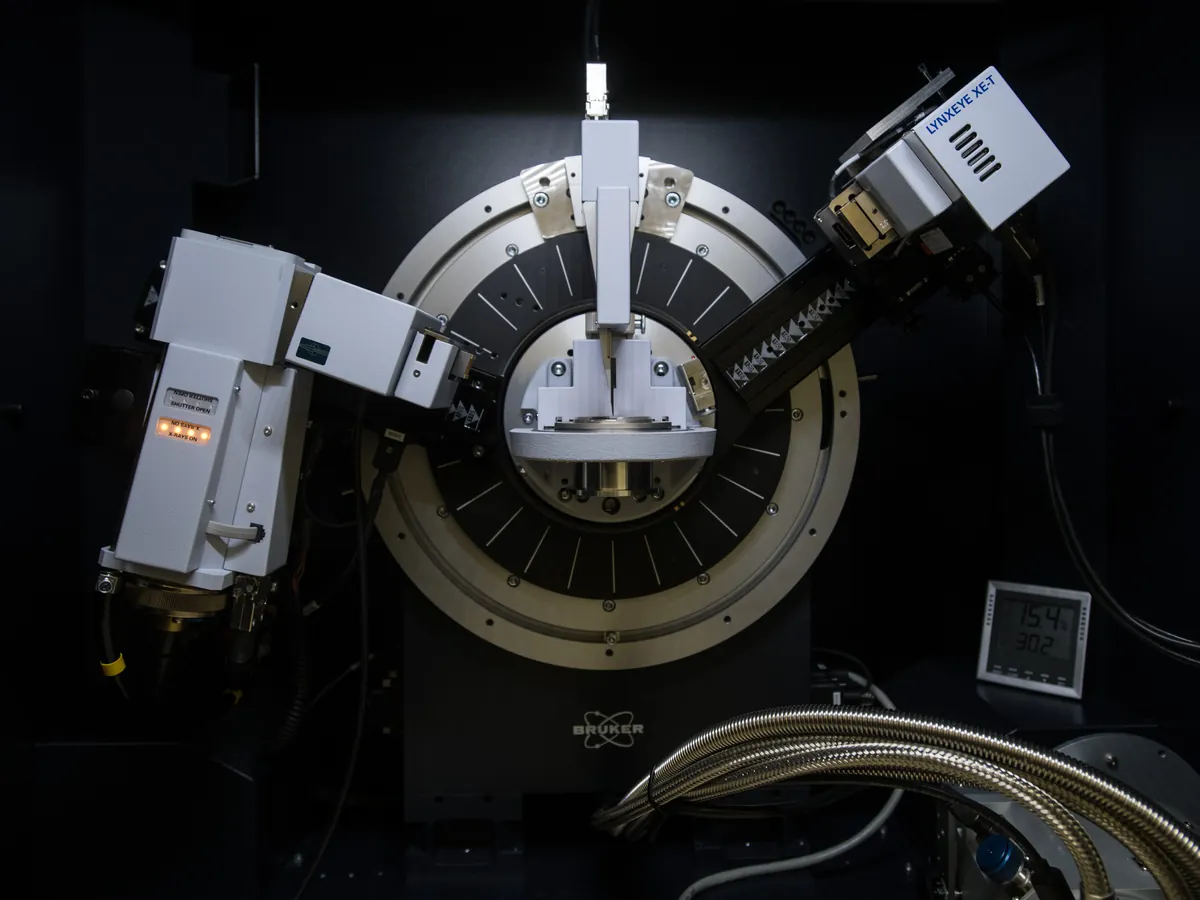
How XRPD works
X-rays scattered by atoms in parallel lattice planes interfere constructively only when Bragg's law is met: nλ = 2d sin θ, where λ is the X-ray wavelength, d the spacing between planes and θ the angle of incidence. Scanning the detector through 2θ records peaks at the angles that satisfy this for each set of planes. The list of 2θ positions and relative intensities is the fingerprint of the crystal form.
The path of a sample
- 01
X-ray tube
Electrons hit a copper anode and produce characteristic Cu Kα X-rays.
- 02
Incident beam optics
Slits, a filter or monochromator and Soller slits shape and clean the beam.
- 03
Sample
A flat, level powder bed (often on a zero-background silicon holder) is rotated or spun to average many crystallites.
- 04
Diffraction
Crystallites oriented to satisfy Bragg's law diffract X-rays at angle 2θ.
- 05
Detector
A position-sensitive or strip detector counts diffracted X-rays across the 2θ range (e.g. 2–40° 2θ).
- 06
Pattern evaluation
Software finds peak positions and intensities and compares the pattern with reference patterns of known forms.
Main parts and what they do
X-ray tube and generator
Copper-anode tube powered at typically 40 kV and 30–40 mA; produces the X-ray beam.
Goniometer
Precision mechanism that sets the angles of the tube, sample and detector (θ–θ or θ–2θ geometry).
Beam optics
Divergence and anti-scatter slits, Soller slits, Kβ filter (nickel) or monochromator to define and clean the beam.
Sample stage and holders
Spinner or multi-position changer; zero-background silicon plates or cavity holders for small samples.
Detector
Scintillation, or more commonly a fast 1D strip or 2D area detector, that counts diffracted X-rays.
Radiation enclosure and interlocks
Lead-glass shielded cabinet with door interlocks and warning lamps that stop exposure when opened.
Software and pattern database
Controls scans, finds peaks, compares with in-house reference patterns or the ICDD Powder Diffraction File.
Terms every analyst should know
Bragg's law
nλ = 2d sin θ. Larger d-spacings give peaks at lower angles. With Cu Kα (1.5406 Å), d = 3.136 Å gives a peak at 28.44° 2θ (silicon 111).
2θ (two-theta)
The angle between the incident and diffracted beams; the x-axis of an XRPD pattern.
Polymorphism
The ability of a compound to crystallise in more than one arrangement. Polymorphs differ in solubility, stability and melting point.
Amorphous halo
Material without long-range order gives a broad hump instead of sharp peaks; useful for spotting amorphous content.
Preferred orientation
Needles or plates lie flat and enhance some peaks. Gentle sample preparation and spinning reduce it; peak positions are more reliable than intensities.
Identity criterion
Typically, the 2θ positions of the sample and reference agree within about ±0.2° 2θ, with consistent relative intensities, as described in USP <941> and Ph. Eur. 2.9.33.
Keep every XRPD in control: usage logs, calibration and maintenance schedules, and automatic blocking of overdue instruments.