Particle & solid-state
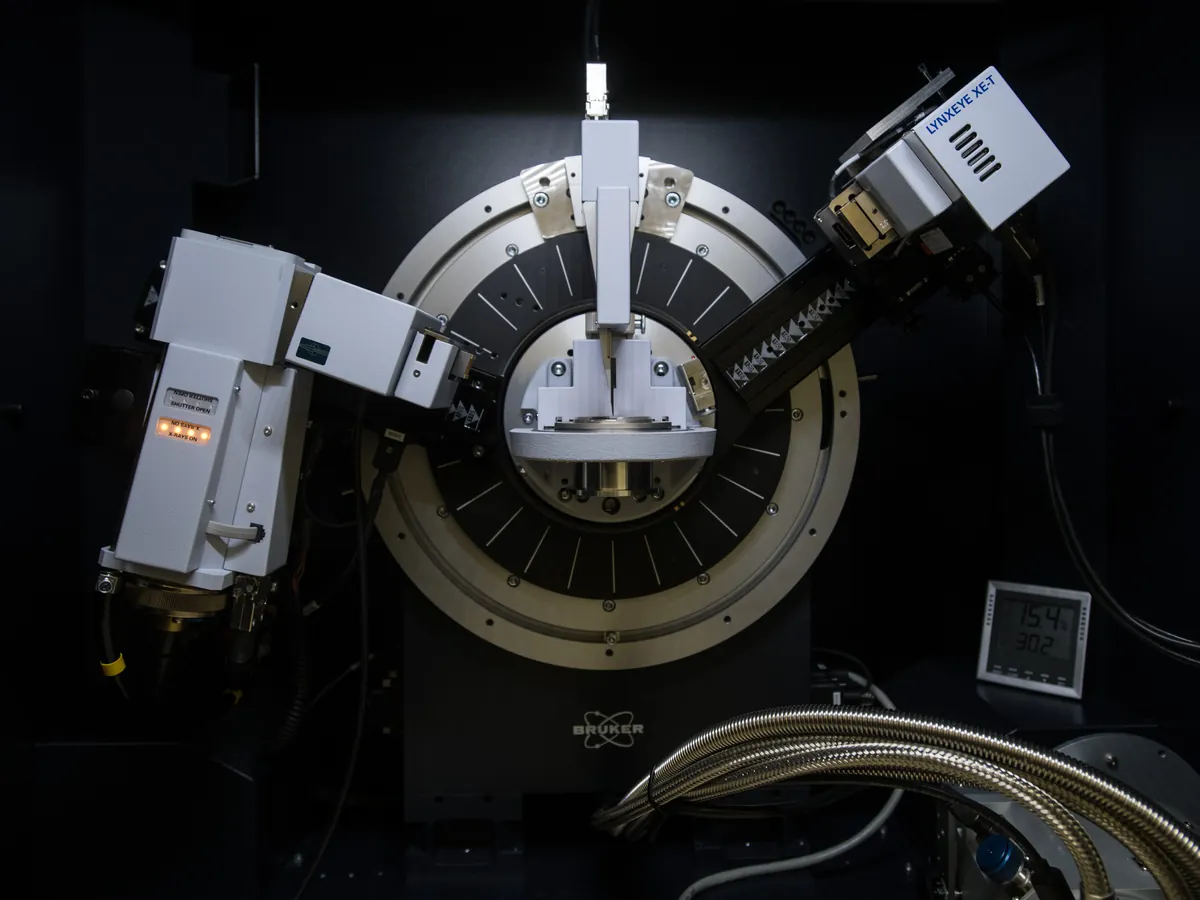
X-ray powder diffractometer (XRPD)
Directs X-rays at a powder and records the angles at which they are diffracted by the crystal lattice. The pattern is a fingerprint of the crystal form, used to identify polymorphs, salts and hydrates and to detect amorphous content.
- Pharmaceutical
- Minerals & mining
- Cement & construction
- Materials science
- Chemicals
- Forensics
Follow your site SOP
This is a typical operating sequence for learning. Your instrument model and approved SOP take precedence.
STAGE 1
Before you start
- 1Check the instrument is calibrated (silicon check within date) and the radiation warning lights work.
- 2Wear your dosimeter badge if your site requires it.
- 3Check cooling water or chiller is running for the X-ray tube.
- Never defeat a door interlock.
STAGE 2
Sample preparation
- 1If needed, gently break up lumps with a spatula or a light grind; avoid heavy grinding, which can change the form.
- 2Fill the holder and level the surface flush with the holder rim using a glass slide, without pressing hard.
- 3For small amounts use a zero-background silicon plate.
- Sample height errors shift peak positions; the surface must be flat and level with the reference plane.
STAGE 3
Measurement
- 1Load the holder and close the enclosure door.
- 2Select the approved method (e.g. Cu Kα, 40 kV / 40 mA, 2–40° 2θ, defined step size and time per step, spinning on).
- 3Run the reference standard or reference form if the method requires it, then the samples.
- 4Ramp the generator down to standby after the run, as per site practice.
STAGE 4
Evaluation
- 1Overlay the sample pattern with the reference pattern of the specified form.
- 2Check that characteristic peaks of the specified form are present and those of other forms are absent.
- 3Report peak positions and the conclusion; record any extra peaks for investigation.
- Compare positions first; intensities can vary with orientation and particle size.
In LimsPulse · Calibration Management
Keep every XRPD in control: usage logs, calibration and maintenance schedules, and automatic blocking of overdue instruments.