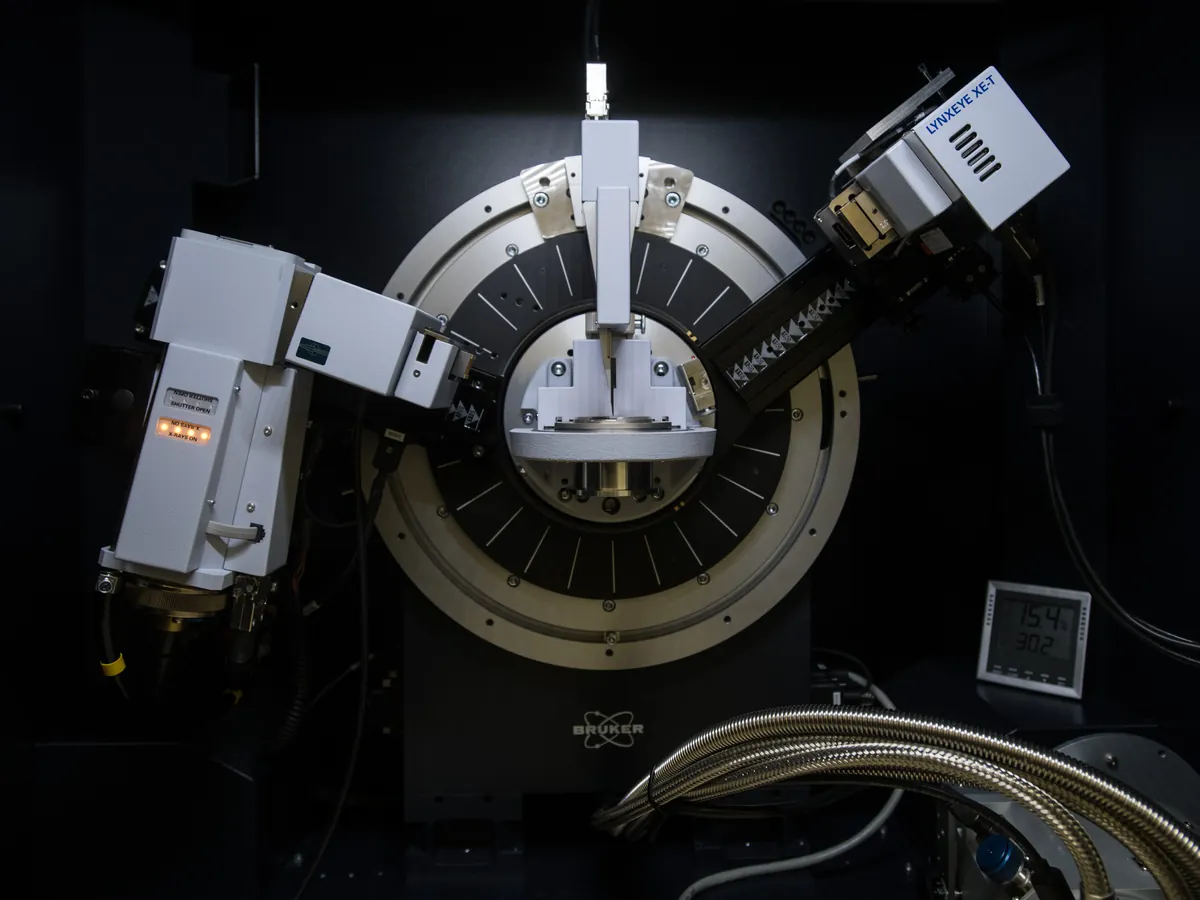
X-ray powder diffractometer (XRPD)
Directs X-rays at a powder and records the angles at which they are diffracted by the crystal lattice. The pattern is a fingerprint of the crystal form, used to identify polymorphs, salts and hydrates and to detect amorphous content.
- Pharmaceutical
- Minerals & mining
- Cement & construction
- Materials science
- Chemicals
- Forensics
Test your XRPD knowledge
Multiple-choice questions
Pick an answer to see whether you are right and why.
Q1. Bragg's law is written as:
basicQ2. Which technique is the reference method for identifying the crystal form (polymorph) of an API?
basicQ3. An amorphous material gives an XRPD pattern with:
intermediateQ4. Relative peak intensities differ from the reference pattern, but positions match. The most likely cause is:
intermediateQ5. Which standard is used to calibrate the 2θ angle scale of a powder diffractometer?
intermediateQ6. Using Cu Kα1 (λ = 1.5406 Å), a lattice spacing of d = 3.1357 Å gives a peak at about:
advancedQ7. All peaks of a sample are shifted by a similar small amount compared with the reference. The first thing to check is:
advanced
Viva questions
Think of your answer first, then open it to compare.
1. Why does crystal form matter for a drug product, and how is it controlled?
Polymorphs can differ in solubility, dissolution rate, stability, hygroscopicity and processability, and sometimes in bioavailability. Following ICH Q6A decision tree #4, the API specification may include a crystal-form test (often XRPD) if forms differ in properties that affect product performance. Development includes a polymorph screen; form is then checked on API batches and, if conversion is possible, in the drug product and on stability.
2. Describe a polymorph screen.
The API is crystallised under many conditions: different solvents and mixtures, cooling and evaporation rates, slurrying, anti-solvent addition, heating and humidity. Each solid is analysed by XRPD to group distinct patterns, then characterised by DSC, TGA, microscopy, Raman or IR and solubility. The most stable form under relevant conditions is usually chosen for development.
3. What radiation safety controls apply to an XRPD instrument?
The X-rays are confined inside a shielded enclosure with door interlocks and warning lamps. Users are trained and authorised, interlocks are never bypassed, leak surveys are done periodically, dosimeters are worn where required and the site follows local radiation licensing rules.
Keep every XRPD in control: usage logs, calibration and maintenance schedules, and automatic blocking of overdue instruments.