Water activity meter
Measures how much of the water in a food is free to support microbial growth and chemical change, as the ratio of the food's vapour pressure to that of pure water. Read on a scale from 0 to 1.
- Food & beverage
- Confectionery and bakery
- Meat and dairy
- Pet food
- Pharmaceutical
- Cosmetics
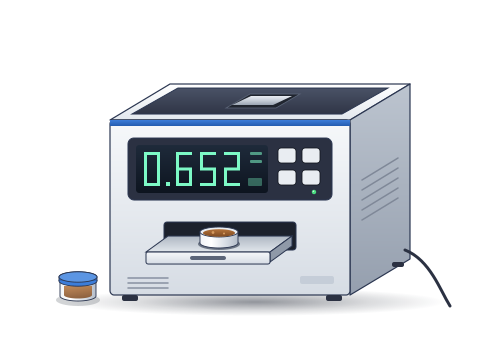
What is aw meter?
Water activity (aw) is not the same as moisture content. Two foods with the same moisture can have very different water activity, because sugar, salt and the food structure bind water. Water activity tells you how available the water is, and that is what controls microbial growth, many chemical reactions, texture and shelf life.
A water activity meter seals a small sample in a chamber at constant temperature. Once the air above the sample reaches equilibrium, the instrument measures its relative humidity. Water activity equals the equilibrium relative humidity divided by 100. Chilled-mirror dew point instruments are the most accurate; capacitance and electrolytic sensors are cheaper and also widely used.
Food safety rules use water activity to decide whether a food needs refrigeration, and to design dried, intermediate-moisture and shelf-stable products. As a rough guide, most pathogenic bacteria need aw above about 0.90, Staphylococcus aureus can grow down to about 0.86, most moulds stop near 0.80, and almost no microbes grow below about 0.60.
Used for
- Shelf-life and safety assessment of dried and intermediate-moisture foods
- Checking whether a product is shelf-stable or needs refrigeration
- Quality control of snacks, confectionery, bakery, jams, dried fruit and meat products
- Predicting moisture migration in multi-component foods
- Pharmaceutical and cosmetic microbial risk assessment
- Sorption isotherm studies in product development
How it works
- 01
Load sample
Fill a clean disposable cup about half full, covering the base.
- 02
Seal chamber
Place the cup in the chamber and close the lid.
- 03
Equilibrate
Water exchanges between sample and headspace at a controlled temperature (commonly 25 °C).
- 04
Measure humidity
Dew point on a chilled mirror, or capacitance change of a humidity sensor, is measured.
- 05
Read aw
The instrument reports aw and temperature once the reading is stable.
Advantages
- Fast: a reading often takes 5–15 minutes
- Non-destructive and needs only a few grams of sample
- Directly related to microbial growth and shelf life
- Easy to verify with salt standards
Limitations
- Strongly affected by temperature; sample and chamber must be at the same controlled temperature
- Volatile substances (alcohol, propylene glycol, acetic acid) can interfere with some sensors
- Does not give moisture content
- Sensor contamination causes drift; regular verification is essential
1 calibration procedure
Methods that use aw meter
Keep every aw meter in control: usage logs, calibration and maintenance schedules, and automatic blocking of overdue instruments.