aw meter · Calibration procedure
Verification with salt standards
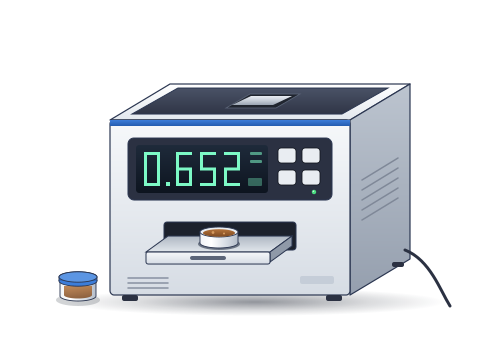
Reads salt solutions of known water activity and checks the meter reads each one within tolerance.
PURPOSE
Why this is checked
Saturated and unsaturated salt solutions have stable, well-known water activities at a given temperature. Reading them confirms the sensor and temperature measurement are accurate across the range used for samples.
Frequency
Typically daily or before each session with one or two standards near the sample range, and a wider multi-point check monthly, as defined in your SOP.
Learn how the aw meter worksYOU WILL NEED
Standards & tools
- Sealed verification standards from the instrument supplier (for example 0.250, 0.760 and 0.984 aw at 25 °C)
- Or saturated salt slurries at 25 °C: lithium chloride about 0.113, magnesium chloride about 0.328, sodium chloride about 0.753, potassium chloride about 0.843, potassium sulphate about 0.973
- Distilled water (aw 1.000) as a top-end check if the manual recommends it
BEFORE YOU START
Prerequisites
- Instrument at its set temperature (commonly 25 °C) and switched on long enough to stabilise
- Standards in date, sealed and at room temperature
- Chamber clean and dry
PROCEDURE
Step by step
- 1Open a standard vial and pour it into a clean sample cup (or use the cup supplied).
- 2Load it into the chamber and start the reading.
- 3Record the aw and temperature once stable.
- 4Repeat with the other standards, from low aw to high aw.
- 5Compare each reading with the standard value at that temperature.
RECORD
Example observation table
| Standard | Expected aw (25 °C) | Reading | Difference |
|---|---|---|---|
| LiCl 13.41 mol/kg | 0.250 | 0.252 | +0.002 |
| NaCl 6.0 mol/kg | 0.760 | 0.762 | +0.002 |
| KCl 0.5 mol/kg | 0.984 | 0.983 | −0.001 |
CALCULATION
How to calculate the result
Formula
Difference = reading − expected aw (at the measurement temperature)
Worked example
- 1
NaCl 6.0 mol/kg standard: 0.762 − 0.760 = +0.002 aw
- 2
All three differences are within ±0.003 aw
ACCEPTANCE CRITERIA
Pass if
- Dew point instruments: typically within ±0.003 aw of the standard
- Capacitance instruments: typically within ±0.01–0.015 aw, or the manufacturer's stated accuracy
- Measurement temperature within the set tolerance (for example 25.0 ± 0.2 °C)
IF IT FAILS
What to do
- Clean the chamber and sensor, then repeat with a fresh standard.
- If still out, adjust the calibration offset as the manual allows and verify again with a second standard.
- If adjustment fails, tag the meter out of use and send it for service.
- Review sample results since the last passing verification.
In LimsPulse · Calibration Management
LimsPulse schedules this calibration, records the result against limits, and blocks the instrument everywhere if it fails or goes overdue.