Water Activity of Food
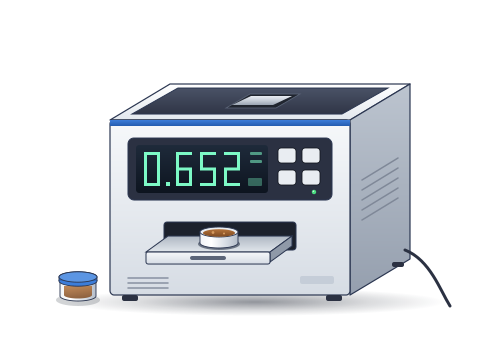
A small portion of food is sealed in the temperature-controlled chamber of a water activity meter. When the headspace reaches equilibrium, the meter reads its relative humidity and reports water activity on a 0–1 scale.
- Food & beverage
- Chilled-mirror dew point or capacitance hygrometry
- aw meter
Reference: Typical method based on ISO 18787 and the instrument manufacturer's method. Measure at a stated temperature, commonly 25 °C.
Why this method works
Water activity is the ratio of the vapour pressure of water over the food to that of pure water at the same temperature. In a small sealed chamber, the air comes into equilibrium with the sample, and its relative humidity divided by 100 equals aw. A chilled-mirror meter finds the dew point of this air; a capacitance meter measures it with a humidity-sensitive polymer. Water activity predicts which microbes can grow and how stable the food will be.
Instruments used
Reagents & standards
| Reagent | Grade / specification |
|---|---|
| Verification standards | Salt standards of known aw near the sample range (for example 0.760 and 0.984 at 25 °C) |
Preparing the sample
- 01
Verify
Read a salt standard near the expected sample aw.
- 02
Prepare
Crush or mix the sample quickly; keep it covered.
- 03
Fill cup
Fill the cup about half full, covering the base.
- 04
Read
Seal in the chamber and wait for a stable reading.
- 05
Duplicate
Repeat on a second portion and report the mean.
Procedure
- 1Allow the meter to stabilise at 25 °C and verify it with one or two salt standards.
- 2Keep samples in sealed containers until they are at about the measurement temperature.
- 3For mixed products (for example filled biscuits), test each component separately or homogenise quickly, as your method states.
- 4Fill a clean disposable cup about half full and keep the rim clean.
- 5Load the cup, close the chamber and start the reading. Record aw and temperature when stable.
- 6Repeat with a second portion and report the mean to three decimal places.
Standard preparation
- 1Use supplier-sealed verification standards, or prepare saturated salt slurries and let them equilibrate before use.
Notes for analysts
- Water activity and moisture content are different. A jam with 30% moisture can have a lower aw than bread with 35% moisture because sugar binds water.
- Samples with alcohol or volatile acids can disturb capacitance sensors; use the correct sensor or filter.
- Always quote the temperature with the result, because aw changes with temperature.
Method parameters (typical)
| Temperature | 25.0 °C (commonly; always report the temperature) |
|---|---|
| Sample amount | Cup about half full (a few grams) |
| Reading time | About 5–15 min for dew point instruments; longer for capacitance sensors |
| Resolution | 0.001 aw |
System suitability & sequence
| Parameter | Limit |
|---|---|
| Salt standard | Within ±0.003 aw (dew point) or the manufacturer's stated accuracy |
| Duplicate agreement | Typically within ±0.005–0.01 aw |
Typical sequence
- 1Verification standard
- 2Sample prep 1
- 3Sample prep 2
- 4Repeat standard at the end of a long session
Calculation with a worked example
Where
- p
- Water vapour pressure over the sample
- p₀
- Vapour pressure of pure water at the same temperature
- ERH
- Equilibrium relative humidity of the headspace (%)
Given
- Product
- Soft cake, tested at 25.0 °C
- Reading 1
- 0.853 (ERH 85.3%)
- Reading 2
- 0.857 (ERH 85.7%)
Working
- 1Mean aw = (0.853 + 0.857) ÷ 2 = 0.855
- 2
Difference between duplicates = 0.004 aw, within ±0.005
Water activity = 0.855 at 25 °C
What result passes
- Compare with the product specification or safety target.
- As a guide: aw above about 0.85 (together with pH above 4.6) generally means a low-acid food needs a validated preservation step or refrigeration; most moulds stop growing near 0.80 and almost no microbes grow below about 0.60.
Validation parameters (ICH Q2(R2))
| Parameter | Typical requirement |
|---|---|
| Accuracy | Salt standards across the range within instrument specification |
| Precision | Repeat readings within about ±0.005 aw |
| Robustness | Effect of temperature, sample amount and equilibration time |
Run this method in LimsPulse: specifications and STPs under version control, results calculated and checked against limits, and a signed Certificate of Analysis.